National Pingtung University of Science and Technology / Prof. Wu Ting-Yu
Pain Points Solved
In recent years, the incidence rate of colorectal cancer in Taiwan has firmly ranked first. One of the reasons is that current preventive colorectal cancer detection methods rely on fecal occult blood screening and colonoscopy. These examination processes are time-consuming, causing many people to shy away from them. More importantly, most people do not have the habit of regular screening. If this detection could be completed in a home environment, it would help with early prevention.
When this system detects an occult blood reaction, a more detailed examination at a medical institution is required. Medical institutions usually use a colonoscope to inspect the intestine, locate the bleeding point, and then perform polyp removal or relevant medical treatments. However, inserting an endoscope deep into the intestine can touch the intestinal wall and cause discomfort. Therefore, if the examination time can be completed as quickly as possible, it will help reduce the patient's discomfort. Simultaneously, shortening the examination time also improves detection efficiency.
Technology Introduction
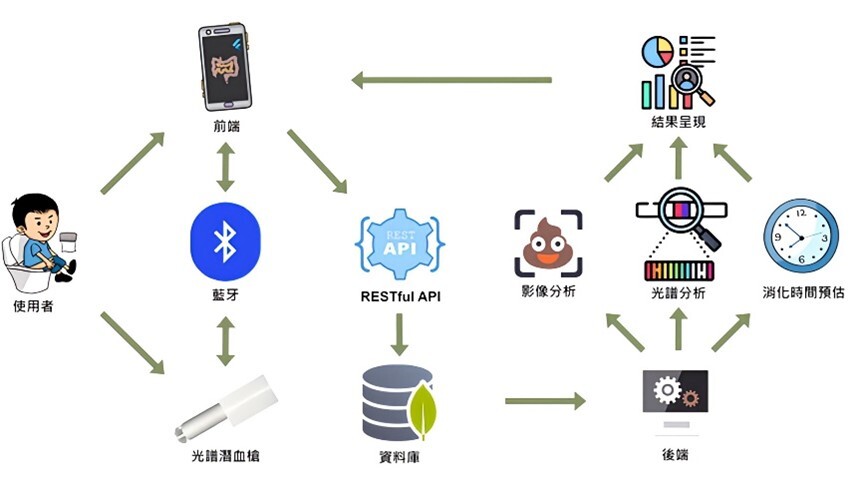
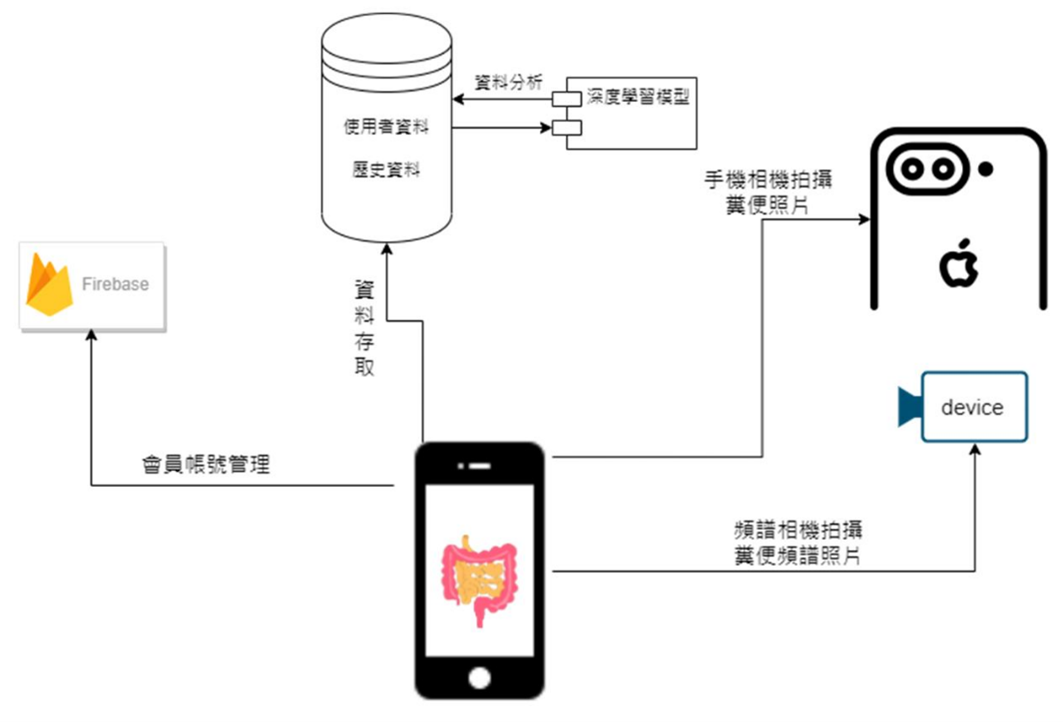
The detection principle of this system utilizes the spectral response of occult blood to determine if an occult blood reaction has occurred in the feces. By taking photos of the feces with a mobile phone, the system performs feature extraction (bubbles, foreign objects, color), health score measurement, and provides auxiliary diagnostic results. This is then combined with the occult blood results and a digestive system-related questionnaire filled out by the subject in the App. Finally, the system estimates the location of intestinal bleeding using a sub-system AI model based on the oxidation spectral interpretation time of the blood at the bleeding site and the intestinal digestion time.
Application Examples
Countries around the world are gradually incorporating fecal occult blood screening into national health screenings. This move can effectively reduce the incidence and mortality rate of colorectal cancer. Therefore, this project will be able to collaborate with toilet manufacturers to develop smart toilets, providing subjects with the ability to test while using the toilet at home. This achieves the effect of "prevention is better than cure," while also reducing the burden on medical institutions and increasing their screening capacity. More importantly, this industrial business opportunity is also a potential global business opportunity.
Related Links
None
Patent Name and Number
None
Industry-Academia / Tech Transfer Partner
None
Honors and Awards
2023/12: Received the 2023 "Industry-Academia Cooperation Project Results Presentation and Performance Evaluation Meeting" - Excellent Industry-Academia Result Award from the Department of Engineering and Technologies, NSTC.
2022/11: Participated in the Ministry of Digital Affairs, Ministry of Education, and CSIM — 2022 27th International ICT Innovative Services Awards (InnoServe Awards), won 1st Place in the AIoT Innovation Application Group. Work name: "Home Intestinal Disease Health Check System".
2022/10: Participated in the Ministry of Education — 2022 National College Intelligent Innovation and Cross-Domain Integration Creation Competition, won 2nd Place in the IoT Group. Work name: "Home Intestinal Disease Detection System".
Technical Contact
Joan Li, Project Manager
National Pingtung University of Science and Technology
Tel: +886 8-7703202 ext. 6571
Email: joanli@mail.npust.edu.tw