National Pingtung University of Science and Technology / Assistant Professor Wei-Yu Chen
Pain Points Solved
Under the global 2050 net-zero carbon emission goal and carbon tariff collection, the high-energy-consuming textile industry will be among the first targets for taxation. The recycling of textile raw materials has become one of the key methods for carbon reduction. The National Development Council has released "Taiwan’s 2050 Net-Zero Transition Path and Strategy," which mentions that textile technology needs to improve the use of recycled materials as alternative raw materials for the circular economy, low-carbon processes, and zero-carbon emission improvements.
However, polyester fiber usage exceeds 50 million tons annually. Therefore, using one kilogram of recycled polyester can reduce energy consumption by 84% and reduce CO2 emissions by 9.4 kg, achieving the future development trends of low energy consumption, resource circulation, and zero waste. This technology uses in-situ polymerization to develop fluorescent carbon dot polyester masterbatches, which can be blended with recycled polyester pellets for the spinning process. This further creates recycled polyester textile fibers containing textile tracking materials, establishing a production history for recycled textile raw materials between providers and brand operators, achieving "carbon footprint" traceability functions.
Technology Introduction
Recycled polyester fiber combined with fluorescent carbon dots enables traceability of recycled raw materials and carbon footprints.
This technology synthesizes fluorescent carbon dot polyester masterbatches in-situ using biopolymers (≤150 kDa), ethylene glycol, and terephthalic acid under high temperature and pressure (2 torr, ≤290°C). After being blended with recycled raw materials, it is spun to form recycled polyester fibers containing tracers, featuring photothermal stability and anti-counterfeiting properties. This technology allows for rapid on-site analysis and the establishment of product history, realizing the zero-carbon goal.
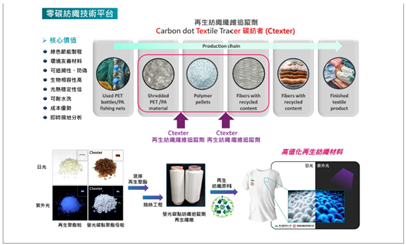
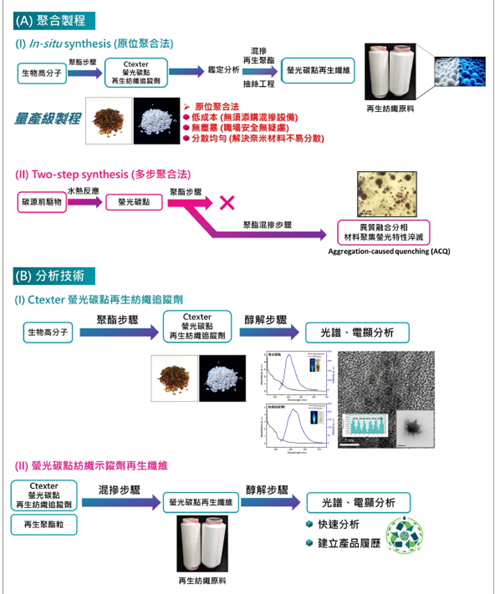
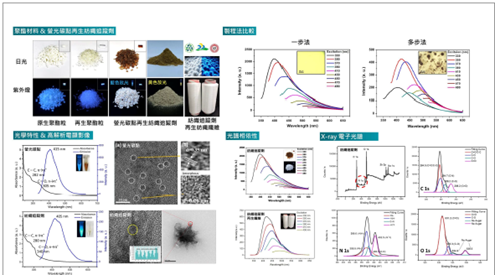
▲Figure. Zero Carbon Textile Technology Platform
Application Examples
The green process fluorescent carbon dot polyester masterbatch serves as an environmentally friendly green material for textile tracers, achieving low energy consumption and resource circulation development trends. Providers of recycled textile raw materials can market to sports and apparel brands at prices superior to similar products by reducing equipment investment and production costs. Simultaneously, as a textile tracking technology developed in Taiwan, it can establish a carbon footprint production history for recycled textile raw materials, achieving the goal of net-zero carbon emissions.
Related Links
None
Patent Name and Number
None
Industry-Academia / Tech Transfer Partner
None
Honors and Awards
National Innovation Award: Academic Research Innovation Award
20th National Innovation Excelsior Award
Technical Contact
Joan Li, Project Manager
National Pingtung University of Science and Technology
Tel: +886 8-7703202 ext. 6571
Email: joanli@mail.npust.edu.tw