Kaohsiung Medical University / Prof. Chih-Hung Chuang
Pain Points Solved
Technology Introduction
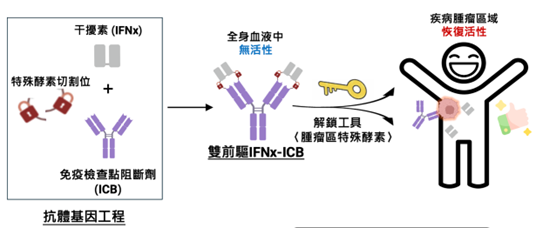
This technology combines interferon and immune checkpoint inhibitors, utilizing a dual pro-antibody platform to enhance tumor specificity, promote T-cell activation within the tumor microenvironment, reduce systemic immune toxicity, and improve ICB efficacy in patients with low tumor antigen expression.
Immune checkpoint inhibitor therapy is one of the most promising strategies for clinical cancer treatment. Yervoy® functions by binding to CTLA-4 on T cells, leading to T cell proliferation and activation. However, Yervoy® can cause systemic immune-related adverse effects or tumor immune evasion, limiting its clinical application. In this study, we developed a fusion antibody, IFN-γ-Yervoy, and demonstrated that IFN-γ does not alter the fundamental properties of Yervoy®. Functionally, IFN-γ-Yervoy is activated by matrix metalloproteinases (MMPs) and enhances the IFN-γ signaling pathway. In the future, more immunotherapies may require such antibodies to locally activate cancer cells or immune cells, improving both the efficacy and safety of cancer treatment.
Application Examples
Applicable to immune-cold tumors such as melanoma and colorectal cancer, particularly in PD-L1 low-expression or ICB-resistant patients. It can be used as monotherapy or in combination with other ICBs to enhance treatment response rates and reduce side effects.
Related Links
None
Patent Name and Number
PCT/CN2025/084866
Industry-Academia / Tech Transfer Partner
None
Honors and Awards
21st National Innovation Award-Academia & Research Innovation Award
Technical Contact
Mr. Hung, Assistant Manager
Kaohsiung Medical University
Tel: +886 7-3121101 ext. 2360
Email: R121084@kmu.edu.tw