Kaohsiung Medical University / Prof. Yu-Sheng Yang
Pain Points Solved
- Conventional hand rehabilitation devices often rely on complex mechanisms, making them difficult to don and maintain and driving up costs. This design simplifies the structure and leverages 3D printing to significantly reduce manufacturing costs.
- An ergonomic design with optimized joint axis alignment enables more natural and smooth movements, reducing discomfort during prolonged use.
- Electric micro linear actuators provide adjustable power assistance, allowing the device to adapt to the user’s needs at different stages of rehabilitation.
- Wireless control enhances ease of use, reduces reliance on external assistance, and supports independent home-based rehabilitation.
Technology Introduction
Current post-stroke hand rehabilitation devices often use complex mechanisms, creating donning and maintenance challenges. This invention offers a precise and simplified design, solving these problems with an affordable price while ensuring the effectiveness of rehabilitation. This streamlined device facilitates thumb, index, and middle finger grasping and opening exercises. Ergonomic design and customizable power assist, delivered via electric micro linear actuators, ensure user comfort and adaptability.
This affordable, 3D-printed hand rehabilitation device is lightweight, easy to use, and customizable, with wireless control and adjustable power assist. This home device helps stroke patients improve hand function and independence through self-rehabilitation. It's also beneficial for post-surgery tendon injury recovery.
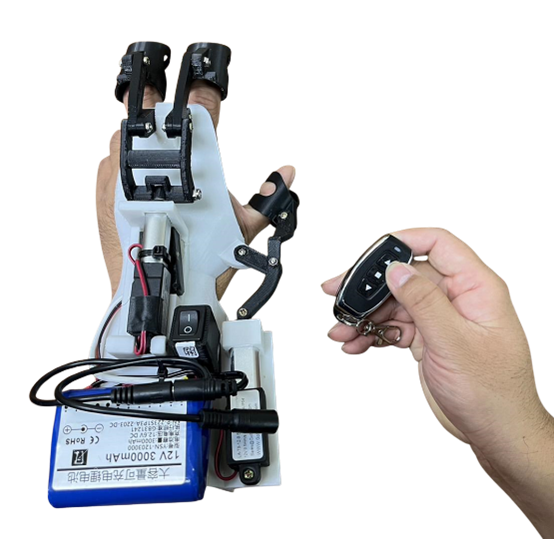
Figure. Finger Continuous Passive Motion Device
Application Examples
- Stroke patients can independently perform thumb, index, and middle finger grasping and opening exercises at home, supporting neuromuscular recovery.
- Patients recovering from hand tendon injuries or post-surgical procedures can use the device for joint mobility exercises to prevent stiffness and accelerate recovery.
- Rehabilitation centers can deploy the device as an assistive training tool to reduce therapist workload and improve training efficiency.
- Educational and research institutions can use the device for demonstrations and studies related to the design and application of rehabilitation assistive devices.
Related Links
None
Patent Name and Number
TW I832791
Industry-Academia / Tech Transfer Partner
None
Honors and Awards
None
Technical Contact
Mr. Hung, Assistant Manager
Kaohsiung Medical University
Tel: +886 7-3121101 ext. 2360
Email: R121084@kmu.edu.tw