
National Sun Yat-sen University / Prof. (Distinguished) Linus Y.S Chiu
Pain Points Solved
Traditional ship radiated noise measurement, whether conducted in shipyard docks or open marine environments, is constrained by several long-standing technical bottlenecks. In enclosed dock environments, severe multipath interference caused by repeated reflections from surrounding structures obscures the true noise sources, significantly degrading measurement reliability. In dynamic marine environments, background noise, time-varying transmission conditions, and uncertainties in the relative position between the ship and sensors further distort the acquired data, making it difficult to accurately characterize the ship’s true acoustic source properties under different operating and sailing conditions. These limitations not only compromise the evaluation of ship silence performance but also restrict subsequent design optimization, tactical planning, and performance verification of acoustic monitoring systems.
To address these challenges, this technology proposes a systematic solution built upon an integrated static–dynamic underwater radiated noise measurement technology chain. For static measurements, the combination of multipath propagation effect analysis and dock-induced reflection mitigation enables dockside measurements—traditionally dominated by reflection artifacts—to reconstruct underwater radiated noise spectra that closely approximate real operating conditions. When further integrated with inboard vibration and airborne noise measurements, the full noise transmission path—from onboard mechanical sources to underwater acoustic radiation—can be quantitatively linked, supporting the establishment of a traceable and continuously improvable ship silence performance database.
For dynamic measurements, the integration of acoustic source localization, transmission loss estimation, and ship radiated noise source spectrum estimation enables the reconstruction of true radiated noise characteristics under different sailing states, even in complex and time-varying marine environments. This integrated approach significantly enhances the accuracy, robustness, and practical usability of radiated noise spectrum reconstruction.
In summary, the core value of this technology lies in overcoming key limitations of traditional methods, including insufficient measurement accuracy, inability to localize noise sources, and difficulty in separating environmental interference from source characteristics. It provides a comprehensive underwater radiated noise measurement and analysis solution applicable to both dockside and marine environments. Beyond improving the efficiency and credibility of ship silence design optimization, this technology supports ship verification, quality control, tactical noise management, and the establishment of acoustic signature databases, offering substantial practical value for ship R&D entities as well as operation and maintenance organizations.
Technology Introduction
1. Ship Radiated Noise Static Measurement Technology: A comprehensive technology specifically for static measurement of ship radiated noise in shipyard docks or enclosed environments, containing 6 technologies:
2. Ship Radiated Noise Dynamic Measurement Technology: A comprehensive technology for dynamic measurement of ship radiated noise in marine environments, containing 5 technologies:
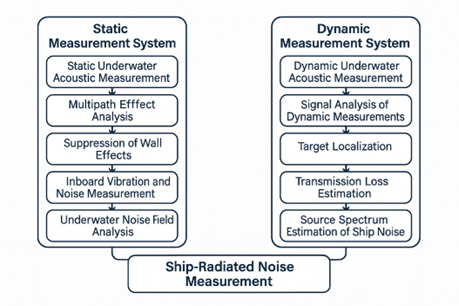
Figure1. This diagram illustrates the complete system architecture of the ship radiated noise measurement technology, including two major modules: "Static Measurement System" and "Dynamic Measurement System." Static measurement integrates underwater noise measurement, multi-path effect analysis and elimination, inboard vibration noise measurement, and background noise analysis to reconstruct true radiated noise characteristics in docks or enclosed environments. Dynamic measurement combines signal analysis, target localization, transmission loss estimation, and source spectrum reconstruction to obtain radiated noise information of ships under different sailing states in marine environments. The integration of both provides a complete technology chain for ship silence performance assessment and acoustic signature analysis.
Application Examples
This technology has been successfully applied to establish the Integrated Dynamic Underwater Radiated Noise Analysis Software. The software fully integrates both static and dynamic ship radiated noise measurement technologies and modularizes key functions according to practical measurement and analysis workflows. Core functional modules include multipath propagation effect processing, transmission loss estimation, inboard vibration and airborne noise analysis, and ship radiated noise source spectrum reconstruction. By integrating measurement data, acoustic numerical models, and marine environmental information, the system supports the entire workflow—from data preprocessing and analytical computation to comparative assessment and result visualization—within a single unified platform.
The software has been practically deployed in multiple ship noise assessment applications, including dockside static radiated noise testing, sea trial noise measurement verification, source level comparison, and noise transmission path analysis. With the support of this integrated platform, users can efficiently characterize ship radiated noise under varying environments and operating conditions, significantly reducing analysis time while improving interpretability and accuracy. The software therefore provides a robust technical foundation for shipbuilding entities, R&D organizations, and verification authorities to conduct silence design optimization, performance inspection, and long-term acoustic signature archiving.
Related Links
None
Patent Name and Number
None
Industry-Academia / Tech Transfer Partner
Tech Transfer Partner: CSBC CORPORATION, TAIWAN
Honors and Awards
None
Technical Contact
Industrial Liaison Office
National Sun Yat-sen University
Tel: +886 7-5250165
Email: gloria@mail.nsysu.edu.tw