
I-SHOU University / Prof. Wu Jung-Ching
Pain Points Solved
Commercially available thermal imagers are generally expensive. Furthermore, during the radiation transmission process, infrared energy is easily absorbed by water vapor and carbon dioxide in the air, leading to the attenuation of radiation energy received by the lens. This limits the measurement range of the thermal imager and causes measurement errors exceeding ±5°C.
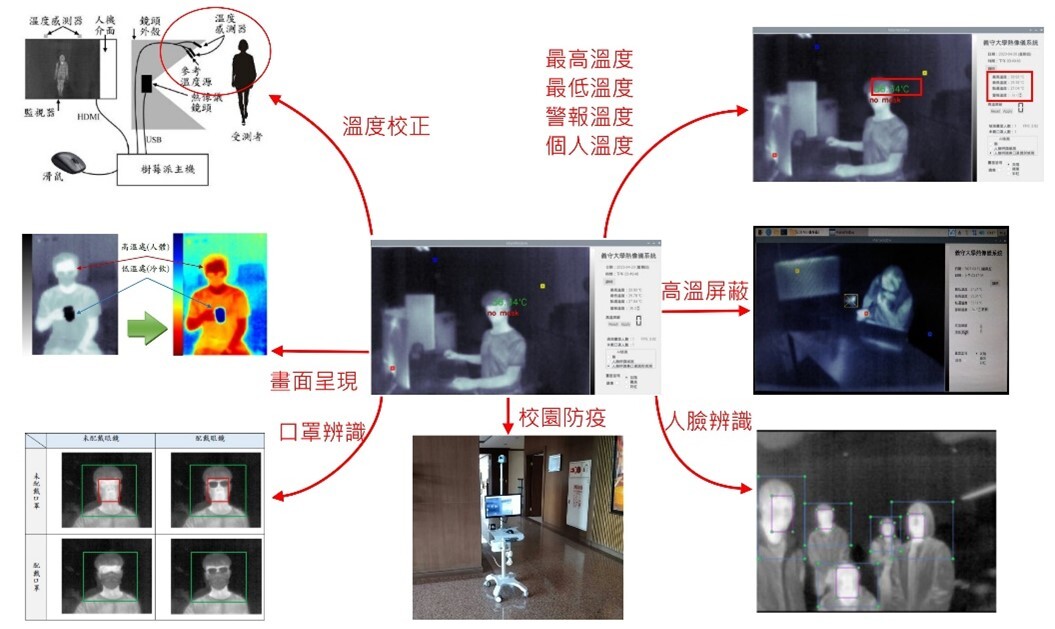
To address the issues of insufficient lens accuracy and thermal radiation attenuation over distance, this research proposes two calibration methods:
1. Two temperature sensors are used as reference precision temperature sources. One is heated to 50°C, and along with the sensor at room temperature, an interpolation method is used to perform temperature calibration on the thermal image. The effect covers the range of human body temperature.
2. Temperature compensation is performed based on model detection positioning results. The farther the distance from the lens, the smaller the screened subject appears on the screen. A suitable compensation formula is calculated using the least squares method to perform temperature compensation.
By combining these two calibration methods, the accuracy can reach within ±0.5°C, and the screening range can exceed 5 meters. The system possesses advantages such as high precision, wide screening range, and diverse functions. This system was actually used for epidemic prevention work in campuses and hospitals during the pandemic.
Technology Introduction
This work utilizes a Raspberry Pi and a thermal imaging lens to build a thermal imaging system with face and mask detection and recognition functions. The system uses digital temperature sensors as reference calibration temperature sources for the thermal imager lens. Through the interpolation calibration method proposed in this study, the temperature accuracy is improved from the original ±5°C to within ±0.5°C .
Simultaneously, to solve the attenuation problem of thermal radiation due to distance limitations, temperature compensation is applied to detected personnel based on model detection positioning results. Experimental results show that the temperature error can be less than ±0.5°C, effectively expanding the screening range to over 5 meters.
Application Examples
During the COVID-19 pandemic (2019-2021), this work assisted I-Shou University in deploying 8 self-developed thermal imaging systems, serving as epidemic prevention screening and mask recognition/reminder systems.
Related Links
https://www.youtube.com/watch?v=IiUeCnwh-nQ
Patent Name and Number
ROC Patent I805347
Industry-Academia / Tech Transfer Partner
None
Honors and Awards
1. Wu Jung-Ching, et al., "Establishing an Infrared Thermal Imaging System with Mask Recognition and Temperature Calibration using Raspberry Pi," 2023 Green Idea Invention and Design Competition, Chia Nan University of Pharmacy & Science, 2023.8.4 (Silver Medal).
2. Wu Jung-Ching, et al., "Establishing an Infrared Thermal Imaging System with Mask Recognition and Temperature Calibration using Raspberry Pi," Wanrun 2023 Innovation and Creativity Competition, Kun Shan University, Tainan, 2023.10.19 (Best Application Award).
3. Wu Jung-Ching, et al., "Establishing an Infrared Thermal Imaging System with Mask Recognition and Temperature Calibration using Raspberry Pi," 2023 National College Industry-Academia Innovation Implementation Competition, National Changhua University of Education, 2023.11.23 (3rd Place).
4. Wu Jung-Ching, et al., "Thermal Shadow Intelligence - Establishing an Infrared Thermal Imaging System with Face/Mask Recognition and Precise Temperature Calibration using Raspberry Pi," CTCI Foundation Science and Technology Scholarship, Taipei, 2023.12.23 (Creativity Scholarship).
Technical Contact
Yu-Hui Huang, Manager
I-SHOU University
Tel: +886 7-6577711 ext. 2194
Email: yuhuihuang@isu.edu.tw