
I-SHOU University / Prof. Yaotsu Chang
Pain Points Solved
If x is an element in a finite field GF( , then the trace function Tr(x) of x is defined as follows:

Our patent uses the simplest method to obtain the trace function value: for example, for an 8-bit element (n=8) in a finite field GF( :
:

To find the trace function value Tr(x), here is a comparison between the current method and our method:
|
|
|
|
The more complex the formula, the more components are needed for hardware implementation, which in turn consumes more energy and takes more time.
Technology Introduction
All text, images, photos and videos seen, and all sounds and music heard on mobile phones (or on televisions and computer screens) are processed through digital technology (or simply, they are all related to a string of 0s and 1s). Finite field theory is an important mathematical theory used to deal with 0s and 1s, playing a crucial role in encoding, cryptography, and communication applications. It can also be used in quantum technology applications.
Among the applications of finite fields, the trace function is an important function, used in encoding, cryptography, and communication.
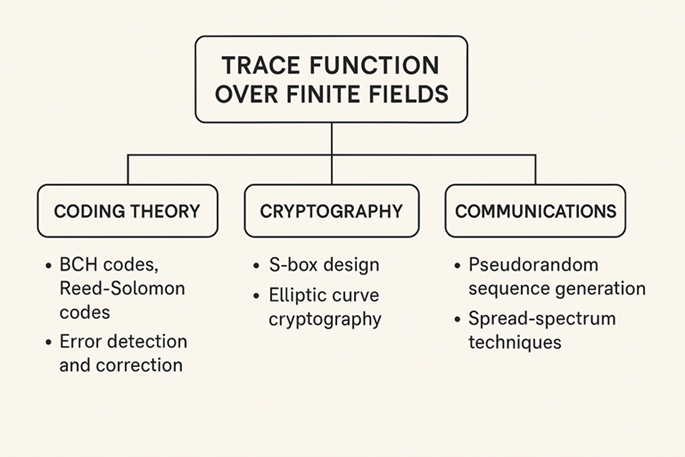
Application Examples
1. Practical Applications in Coding Theory
2. Practical Applications in Cryptography
 ) to the base field GF(2)
3. Applications in Communication Systems
Summary:
Trace functions are behind-the-scenes mathematical tools in these industrial applications. They don't appear directly in the standard names seen by users, but rather in the underlying formulas of protocols, chip designs, or coding structures. Its practicality has been proven, and it continues to be used in industrial systems such as error correction codes, cryptographic algorithms, and pseudo-random code generation.
Related Links
None
Patent Name and Number
I742371
Industry-Academia / Tech Transfer Partner
None
Honors and Awards
None
Technical Contact
Yu-Hui Huang, Manager
I-SHOU University
Tel: +886 7-6577711 ext. 2194
Email: yuhuihuang@isu.edu.tw

