I-SHOU University / Prof. Chia-Jung Cho
Pain Points Solved
1. Carbon Reduction and Resource Circularity
Agricultural residues that would otherwise be incinerated or landfilled are valorized into high-value functional materials, contributing to carbon-emission reduction and resource circularity. This approach aligns with ESG principles and the United Nations Sustainable Development Goals (SDGs), particularly SDG 12 (Responsible Consumption and Production) and SDG 13 (Climate Action).
2. Enhanced Composite Material Performance
Chemically modified cellulose fibers can form stable composites with biodegradable polymers, offering a combination of lightweight characteristics, high mechanical strength, and intrinsic biodegradability, thereby improving the overall performance of green composite materials.
3. High Potential for Industrial Implementation
The technology demonstrates strong feasibility for scale-up and mass production, with broad application potential in eco-friendly packaging materials, biodegradable containers, green building materials, and agricultural mulch films.
4. Economic Value Creation
The developed approach is expected to reduce the cost of biodegradable plastics by approximately 20–30%, while increasing the added value of recycled materials and facilitating the establishment of a circular agricultural waste valorization industry in southern Taiwan.
Technology Introduction
This technology proposes a multi-stage organic–alkaline–acid extraction combined with silane functionalization for the valorization of agricultural residues. Cellulose-containing by-products, including rice husks, fruit peels, and vegetable leaves, are effectively converted into high value-added precursors for biodegradable composite materials.
The key innovations include:
1. Multi-step extraction and separation process enabling efficient isolation and purification of cellulose-rich fractions;
2. Epoxy-functional silane surface modification, which enhances interfacial compatibility between biomass-derived fillers and polymer matrices;
3. Low-cost, high-value conversion strategy, wherein the modified agricultural residues can be directly utilized as lightweight fillers in composite materials, leading to reduced material density and manufacturing costs while simultaneously improving mechanical strength and processability.
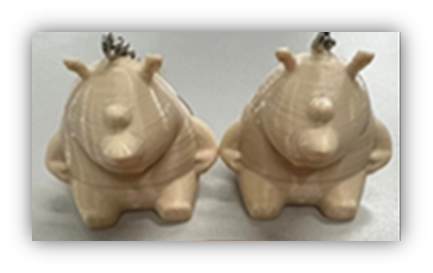
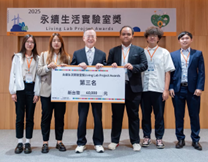
▲Caption: Conversion of agricultural waste into 3D-printed cultural and creative figurines, awarded at the 5th Sustainable Living Laboratory Awards (2025).
Application Examples
This technology has successfully converted agricultural wastes—such as rice husks, fruit peels, and legume pods—into highly compatible biodegradable composite materials. The resulting materials can be blended with biodegradable polymers to fabricate lightweight, eco-friendly products, including: Compostable tableware,Cultural and creative figurines, and 3D printing filaments, thereby partially replacing conventional petroleum-based plastics.
Through hydrophobization of modified cellulose, the composites exhibit enhanced mechanical strength and improved water resistance, while retaining their ability to undergo natural biodegradation after use. This approach effectively achieves a balance between environmental sustainability and material performance.
Related Links
None
Patent Name and Number
No. I866437
Industry-Academia / Tech Transfer Partner
None
Honors and Awards
2025 5th Living Lab Project Awards
Technical Contact
Yu-Hui Huang, Manager
I-SHOU University
Tel: +886 7-6577711 ext. 2194
Email: yuhuihuang@isu.edu.tw