National University of Kaohsiung / Prof. Wen-Fu Ho
Pain Points Solved
This technology was developed to address key limitations of existing metallic biomaterials used for medical implants, particularly in terms of mechanical strength, elastic compatibility with bone, long-term durability, and biosafety.
1. Addressing Insufficient Strength and Implant Fracture Risk
Conventional biomedical alloys, such as Ti–6Al–4V, 316L stainless steel, and Co–Cr–Mo alloys, are susceptible to plastic deformation and fatigue failure under high-load conditions. The titanium-rich medium-entropy alloys developed in this study exhibit significantly higher bending strength and yield strength, enabling them to withstand greater mechanical loads while maintaining excellent bending deformability. These characteristics effectively reduce the risk of implant deformation and fracture, thereby improving the service life and reliability of medical implants.
2. Mitigating the Stress Shielding Effect
Most metallic implant materials possess an elastic modulus substantially higher than that of natural bone. This mismatch causes stress to be concentrated within the implant rather than being transferred to surrounding bone tissue, leading to bone resorption and potential implant failure. The titanium-rich medium-entropy alloys developed in this work exhibit a relatively low elastic modulus (approximately 90–110 GPa) combined with high resilience, resulting in mechanical properties that more closely match those of human bone. Consequently, stress shielding can be significantly reduced, promoting better osseointegration and enhancing long-term implant stability.
3. Improving Corrosion Resistance and Reducing Metal Ion Release
The physiological environment is inherently corrosive, and prolonged exposure can lead conventional metallic implants to release metal ions, potentially causing inflammatory reactions and tissue damage. The titanium-rich medium-entropy alloys developed in this study demonstrate lower corrosion current densities and superior corrosion resistance. These properties effectively minimize metal ion release, thereby enhancing the long-term stability, safety, and biocompatibility of implant materials.
Technology Introduction
This technology develops a metastable β titanium-rich medium-entropy alloy with excellent mechanical properties and biocompatibility for biomedical implant applications. The alloy exhibits high yield strength (>1100 MPa), low elastic modulus (<110 GPa), high elastic energy storage capability, and superior corrosion resistance in the as-cast condition without requiring additional heat treatment, thereby significantly reducing manufacturing cost and processing complexity. Compared with conventional implant materials such as 316L stainless steel, Co–Cr–Mo alloys, and Ti–6Al–4V alloys, the developed alloy effectively minimizes stress shielding effects and reduces the risk of metal ion release in the human body. Different alloy compositions can be tailored for specific orthopedic applications, including acetabular cups and femoral stems. Owing to its high strength, low modulus, wear resistance, and excellent elastic recovery capability, this technology demonstrates strong potential for next-generation orthopedic and biomedical implant materials.
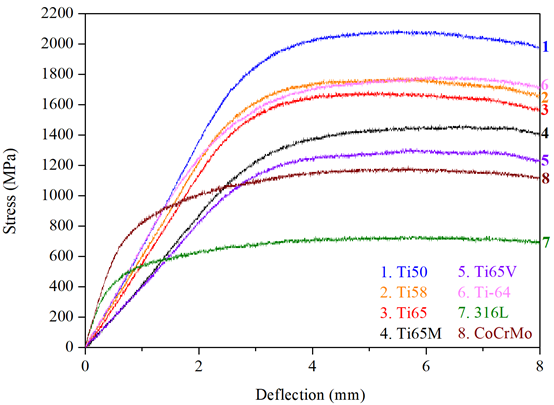
▲Figure 1. Stress–deflection curves obtained from three-point bending tests of the developed medium-entropy alloys and conventional biomedical alloys. The developed titanium-rich medium-entropy alloys exhibited significantly higher bending strength and superior bending deformability (deflection > 8 mm), demonstrating an excellent combination of strength and toughness for reducing implant deformation and fracture risk.
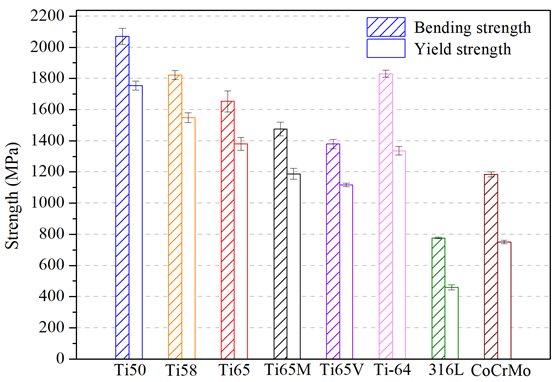
▲Figure 2. Comparison of bending strength and yield strength between the developed medium-entropy alloys and conventional biomedical alloys. The titanium-rich medium-entropy alloys demonstrated substantially higher bending and yield strengths than Ti–6Al–4V (Ti-64), Co–Cr–Mo, and 316L stainless steel, indicating superior load-bearing capability and mechanical reliability for orthopedic implant applications.
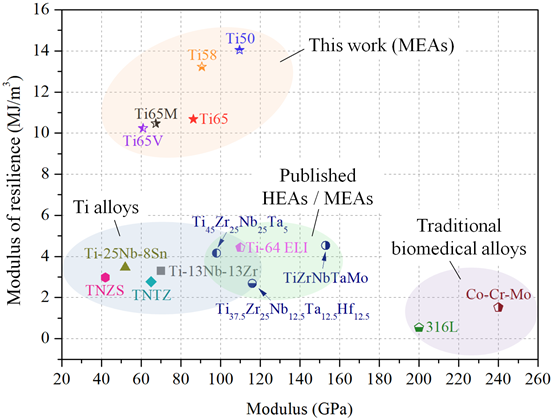
▲ Figure 3. Comparison of modulus of resilience and elastic modulus between the developed medium-entropy alloys and conventional biomedical alloys. The titanium-rich medium-entropy alloys exhibited significantly higher resilience and lower elastic modulus, enabling improved elastic energy storage and reduced stress shielding effects for enhanced load transfer and implant stability.
Application Examples
This technology can be applied to a wide range of advanced medical devices, including artificial joints, bone plates and screws, spinal fixation systems, dental implants, and customized implantable medical devices. Owing to its high strength, excellent toughness, low elastic modulus, and superior corrosion resistance, it can effectively reduce the risks of implant fracture, bone loss caused by stress shielding, and metal ion release. As a result, it enhances treatment outcomes, improves the long-term durability of implants, and demonstrates strong potential for clinical applications and commercialization in the biomedical device market.
Related Links
https://www.youtube.com/watch?v=4pzauUmMOi4
Patent Name and Number
None
Industry-Academia / Tech Transfer Partner
None
Honors and Awards
None
Technical Contact
Vivian Lee, Administrative Assistant
National University of Kaohsiung
Tel: +886 7-5916639
Email: vivianlee@nuk.edu.tw