
National Pingtung University of Science and Technology / Prof. Li-Hsin Wu
Pain Points Solved
Fall armyworm (Spodoptera frugiperda) threatens major crops, while heavy reliance on chemical insecticides raises concerns over resistance and environmental impacts. This technology uses the egg parasitoid Telenomus remus to suppress fall armyworm eggs and evaluates how the endosymbiotic bacterium Wolbachia wRem can improve parasitoid production. Across 23, 27, and 31°C, the infected strain produced about 95% female offspring, significantly higher than the uninfected strain. At 27°C, it also showed higher net and gross reproductive rates, which may enable more efficient mass production of female parasitoids for biological-control programs and reduce dependence on chemical pesticides.
Technology Introduction
Wolbachia is a widespread intracellular symbiotic bacterium in arthropods that can alter host reproduction. The research team collected Telenomus remus from fields in Pingtung and established wRem-infected and uninfected strains. Life-history, sex ratio, reproduction, and parasitism performance were compared at 23, 27, and 31°C. The infected strain produced more than 94% female offspring at all three temperatures. At 27°C, the infected strain reached a gross reproductive rate (GRR) of 61.17 and a net reproductive rate (R₀) of 60.88, significantly higher than the uninfected strain (43.96 and 43.00). Parasitism by T. remus reduced fall armyworm egg hatch from 58.39% in untreated eggs to below 13%. The team has established a standardized rearing process capable of producing more than 5,000 T. remus per week and collaborates with a commercial natural-enemy producer on regular releases. Field validation specifically for the Wolbachia-infected strain remains a next step.
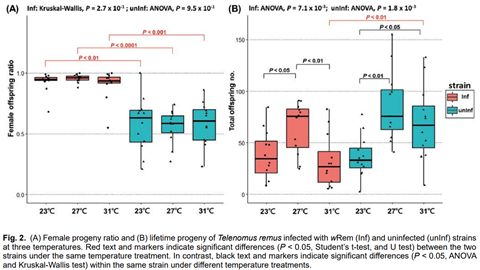
▲Caption: Female progeny ratio (A) and lifetime progeny (B) of wRem-infected (Inf) and uninfected (unInf) Telenomus remus at 23, 27, and 31°C (Wu et al., 2025).
Application Examples
1. Fall armyworm biological control: T. remus parasitizes fall armyworm eggs; in the study, egg hatch after parasitism was below 13%.
2. Mass rearing of natural enemies: the wRem-infected strain produces about 95% female offspring, potentially increasing the output of female parasitoids; 27°C was the best reproductive condition among the temperatures tested.
3. Industry application foundation: the team has a standardized rearing process producing more than 5,000 T. remus per week and collaborates with Yoshida-Tian Natural Enemy Production Company (English company name not provided in source) for regular T. remus releases.
Related Links
Representative publication DOI: 10.1127/entomologia/3076
Patent Name and Number
None
Industry-Academia / Tech Transfer Partner
Industry-Academia Cooperation Unit Name: 吉田田天敵生產公司 (official English name not provided)
Honors and Awards
None
Technical Contact
Joan Li, Project Manager
National Pingtung University of Science and Technology
Tel: +886 8-7703202 ext. 6571
Email: joanli@mail.npust.edu.tw