National Sun Yat-sen University / Prof. Yeng-Ping Peng
Pain Points Solved
Ferrate(VI) exhibits exceptionally strong oxidative capacity and is effective in degrading a wide range of organic and inorganic contaminants. However, its stability in natural aqueous environments is limited, as it is readily reduced to ferric iron (Fe(III)). This rapid reduction results in a short effective oxidation period and restricted treatment range, thereby limiting its applicability for large-scale and long-term environmental remediation. In addition, conventional direct dosing methods often lead to rapid reagent consumption and low utilization efficiency.
To overcome these limitations, the proposed technology employs an encapsulation and controlled-release strategy for Fe(VI), effectively retarding its reduction rate and regulating its release behavior. This approach minimizes instantaneous consumption, enabling sustained release and prolonged oxidative activity in the environment. Consequently, it enhances the overall treatment range and duration, achieving long-term and large-scale remediation performance.
Technology Introduction
In this technology, we first synthesize high-purity Fe(VI) via the wet oxidation method. Hydroxypropyl methylcellulose (HPMC) is then employed as an encapsulation material to coat the Fe(VI). Subsequently, the coated material is compressed using a manual hydraulic press to produce controlled-release ferrate(VI) tablets. The release rate of Fe(VI) can be effectively regulated by adjusting key processing parameters such as the mass ratio of Fe(VI) to the encapsulating material, manufacturing pressure, Fe(VI) dosage, and the number of tablets. This enables prolonged reaction time and enhances both the treatment range and overall efficiency of contaminant remediation.
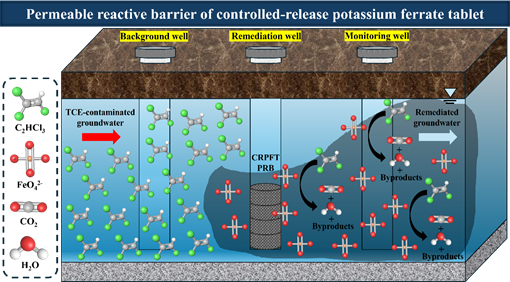
Figure. Potential of controlled-release ferrate(VI) tablets in practical groundwater remediation
Application Examples
Groundwater remediation:This technology has been validated through column experiments that simulate field-scale groundwater flow conditions. The results demonstrate that the developed controlled-release ferrate(VI) tablets can steadily release ferrate(VI) within the aquifer and effectively degrade chlorinated organic contaminants, such as trichloroethylene (TCE).
Related Links
None
Patent Name and Number
None
Industry-Academia / Tech Transfer Partner
None
Honors and Awards
None
Technical Contact
Industrial Liaison Office
National Sun Yat-sen University
Tel: +886 7-5250165#2691
Email: gloria@mail.nsysu.edu.tw