
National Sun Yat-sen University / Prof. Yen-Ping Peng
Pain Points Solved
Receptor models, including Positive Matrix Factorization (PMF) and Chemical Mass Balance (CMB), address the fundamental challenge of quantifying source contributions when direct source measurements are not feasible. Ambient pollutants typically originate from multiple sources and undergo atmospheric transport and transformation, making it difficult to distinguish individual source impacts based solely on concentration measurements. The CMB model utilizes predefined source profiles to quantitatively estimate the contribution of each source to observed concentrations, thereby providing physically interpretable apportionment results. In contrast, PMF applies a multivariate statistical approach to resolve latent source factors directly from measured data, enabling source identification even when complete source profiles are unavailable. Together, these receptor models overcome the limitation of conventional monitoring systems that measure pollutant concentrations but cannot determine their origins. As a result, PMF and CMB provide a scientific basis for air quality management, emission control strategies, and environmental policy development.
Technology Introduction
PMF and CMB are widely used receptor models for source apportionment of environmental pollutants. The CMB model applies the principle of mass conservation and utilizes predefined source profiles to quantitatively estimate the contribution of each emission source to measured concentrations at the receptor site. In contrast, PMF is a multivariate statistical technique that decomposes the observed concentration matrix into source contribution and source profile matrices, incorporating uncertainty estimates to improve model robustness. Both approaches enable the identification and quantification of pollution sources without direct emission measurements, providing essential information on source structure and relative contributions for air quality assessment and management.
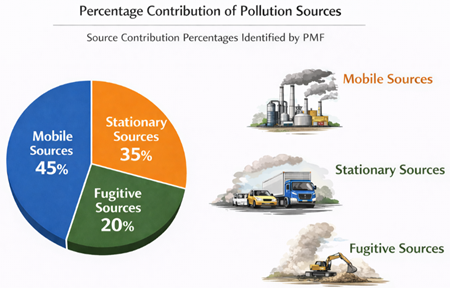
Figure. Percentage Contribution of Pollution Sources analyzed by PMF
Application Examples
PMF was applied for source apportionment to identify potential pollution sources in the Xiaogang Industrial District of Kaohsiung.
CMB combined with PMF was applied to support air quality improvement in the Erlin area of Changhua City.
Related Links
None
Patent Name and Number
None
Industry-Academia / Tech Transfer Partner
None
Honors and Awards
None
Technical Contact
Industrial Liaison Office
National Sun Yat-sen University
Tel: +886 7-5250165#2691
Email: gloria@mail.nsysu.edu.tw