National Sun Yat-sen University / Prof. Yen-Ping Peng
Pain Points Solved
Traditional air pollution assessment approaches (e.g., Gaussian plume/puff models) rely on simplified assumptions and static meteorological conditions, making it difficult to accurately represent complex terrain, temporal variations, and atmospheric dynamics. As a result, pollutant transport and dispersion may be underestimated or misrepresented in practical applications. To address these limitations, TAPM integrates meteorological fields with pollutant transport processes, enabling the simulation of atmospheric dynamics and pollutant concentration variations, and providing more realistic dispersion results as well as support for pollution scenario analysis.
Technology Introduction
TAPM (The Air Pollution Model), developed by CSIRO, is a regional-scale air quality model that integrates meteorological simulation with pollutant transport processes and is categorized as a prognostic model. It employs a Cartesian coordinate system in the horizontal direction and a sigma coordinate system in the vertical direction, allowing effective representation of complex terrain. Driven by synoptic-scale meteorological data and incorporating four-dimensional data assimilation (4DDA), TAPM improves simulation accuracy and is capable of performing both hourly and long-term simulations. It has been widely applied in air quality prediction, environmental impact assessment, and pollution control strategy analysis.
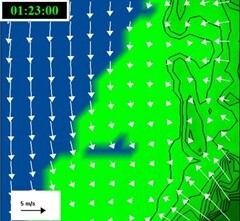
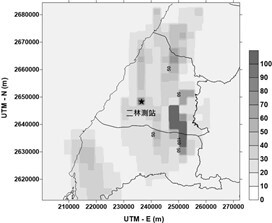
Figure. Wind Field and Ozone Isoconcentration Contours Simulated by TAPM
Application Examples
TAPM is applied to simulate meteorological fields as well as pollutant transport and chemical processes, in order to analyze pollution sources and formation mechanisms. The model is further used to investigate ozone pollution in the Kaohsiung–Pingtung region and PM pollution in Erlin, Changhua, as well as to evaluate corresponding emission reduction strategies.
Related Links
None
Patent Name and Number
None
Industry-Academia / Tech Transfer Partner
None
Honors and Awards
None
Technical Contact
Industrial Liaison Office
National Sun Yat-sen University
Tel: +886 7-5250165#2691
Email: gloria@mail.nsysu.edu.tw