National Pingtung University of Science and Technology / Assoc. Prof. Pei-Chun Chang
Pain Points Solved
Conventional animal leather requires livestock farming and tanning, resulting in high carbon emissions and animal-welfare concerns, while most synthetic leathers are petroleum-based plastics that are difficult to degrade.
This technology grows fungal mycelium on fabric to produce a leather alternative without any animals, using agricultural residues such as banana pseudostem fiber residue and sawdust as culture media, turning farm waste into high-value materials.
Value: Supports animal welfare, carbon reduction and the circular economy. Previous studies show that fungal leather has a carbon footprint as low as about 2.76 kg CO₂e per m², roughly 8% of that of cowhide.
Technology Introduction
Using dry solid-state cultivation, fungal mycelium is grown on synthetic-fiber fabric to form a dense mycelial layer, creating an animal-free composite leather that can be taken forward into material production and finished products. Key results of this phase:
1. Heat-tolerant strain screening: New strains were collected in the field and purified. WB, LHSL1 and LHSL2 showed better mycelial growth, and LHSL2 performed best at high temperatures, forming a dense mycelial layer.
2. Reuse of agricultural residues: A 1:1 mixture of banana pseudostem fiber residue and sawdust can support mycelial growth once a conditioning agent is added.
3. Light-quality testing: Red and blue light had no effect on the growth of the fungal leather, so either can serve as the light source in the cultivation room, simplifying management and automation design.
4. Mycelial layer analysis: FTIR can identify subtle peak differences in the cell-wall composition of three strains, offering a potential rapid strain-comparison tool.
Next steps: continue comparing growth on different media and validate FTIR as a rapid strain-comparison tool.
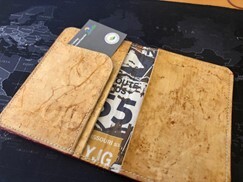
▲Caption: passport cover sewn from fungal leather (no animals harmed).
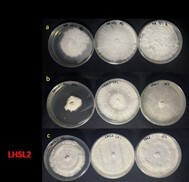
▲Caption: heat-tolerance test of newly purified strains; LHSL2 still forms a dense mycelial layer at high temperature.
Application Examples
Fungal leather has been sewn into finished goods such as a passport cover, demonstrating that the material can be cut and stitched for practical use.
Potential applications include wallets, card holders, passport covers, bags, footwear materials and other fashion accessories and creative products, suited to co-development with sustainable fashion brands and leather-goods makers; partnering with banana-growing regions can secure a steady supply of pseudostem residue as culture media.
Related Links
None
Patent Name and Number
NATURAL LEATHER MATERIAL AND MANUFACTURING METHOD THEREOF WITH CULTURING FUNGI (Taiwan Invention Patent No. I936827)
COMPLEX NATURAL LEATHER MATERIAL AND MANUFACTURING METHOD THEREOF WITH CULTURING FUNGI (Taiwan Invention Patent No. I936826)
Industry-Academia / Tech Transfer Partner
Industry-Academia Cooperation Unit Name: Mr. Fang-Yao Chen
Honors and Awards
None
Technical Contact
Joan Li, Project Manager
National Pingtung University of Science and Technology
Tel: +886 8-7703202 ext. 6571
Email: joanli@mail.npust.edu.tw