
﹤Biotech & Biomed Innovation﹥A Method for Detection of Single Nucleotide
Kaohsiung Medical University / Prof. Chun-Chi Wang
Pain Points Solved
- Conventional gene mutation detection methods require expensive instrumentation and lengthy analysis times, which limit their clinical applicability.
- Existing approaches often rely on highly trained personnel and costly reagents, making them unsuitable for rapid screening.
- This technology simplifies the workflow and reduces costs by combining restriction enzyme digestion with fluorescence signals that are visible to the naked eye.
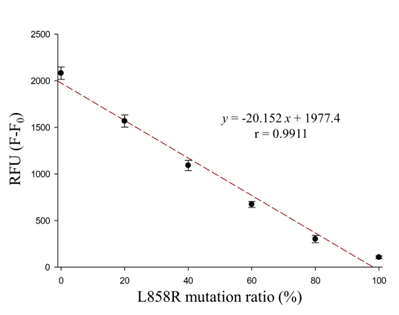
- It enables rapid quantitative determination of single nucleotide mutation ratios, thereby improving the efficiency of clinical genetic testing.
Technology Introduction
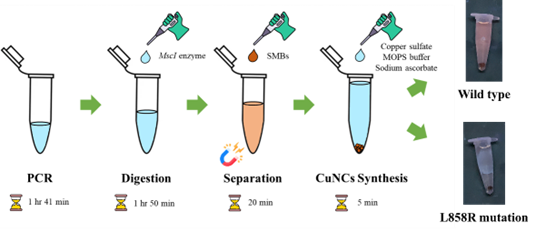
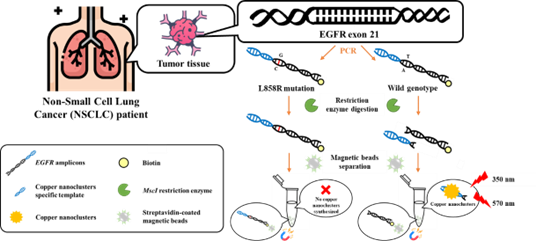
This technology offers an efficient, rapid, and cost-effective approach for the detection of single nucleotide gene mutations. The process begins with the amplification of the target gene fragment utilizing two primers that are labeled with biotin and poly-AAT. Subsequently, the MscI restriction enzyme is employed to selectively digest the non-mutated fragments. Magnetic beads are then utilized to capture the biotin-containing fragments for subsequent separation. In the final step, copper nanoclusters are synthesized in the supernatant, and the resulting fluorescence intensity serves as an indicator of the proportion of the EGFR L858R mutation. The fluorescence intensity is observable to the naked eye, rendering this method suitable for the detection of various single nucleotide mutations and providing a swift and intuitive means for genotype determination.
Application Examples
- Applied to the detection of EGFR L858R mutations in lung cancer patients to support decision-making for targeted therapy.
- Extendable to the screening of single nucleotide mutations associated with other cancers or genetic disorders.
- Suitable for preclinical screening, genetic research, and on-site rapid testing in resource-limited settings.
- With visualized results and minimal equipment requirements, the technology is easily adoptable by primary healthcare facilities.
Related Links
None
Patent Name and Number
TW 112143382
US 18/506,147
Industry-Academia / Tech Transfer Partner
None
Honors and Awards
None
Technical Contact
Mr. Hung, Assistant Manager
Kaohsiung Medical University
Tel: +886 7-3121101 ext. 2360
Email: R121084@kmu.edu.tw