﹤Biotech & Biomed Innovation﹥Interactive Rehabilitation System Using Augmented Reality
I-SHOU University / Prof. Lee Ping-Chia
Pain Points Solved
Traditional rehabilitation therapy relies on face-to-face guidance from therapists, requiring demonstrations, hands-on assistance, or immediate posture correction to ensure patients perform rehabilitation movements correctly. However, this model has several limitations: insufficient manpower and time constraints, issues with efficiency and medical burden, limitations due to distance or pandemics, and poor outcomes from home-based self-rehabilitation due to a lack of immediate feedback and motion monitoring mechanisms, making patients prone to incorrect movements or lack of motivation to continue.
Therefore, this invention aims to create a home rehabilitation method that is instructive, engaging, and measurable through an Augmented Reality (AR) interactive system combined with sensing and gamified operations. This effectively reduces manpower needs and enhances the precision and engagement of rehabilitation movements.
Technology Introduction
This invention proposes an interactive rehabilitation system combining Augmented Reality (AR) technology. Through wearable AR glasses and motion recognition modules, it tracks the patient's limb movements in real-time and guides correct rehabilitation postures with virtual images. The system is equipped with interchangeable handles and various auxiliary props to simulate different operational scenarios according to rehabilitation needs, allowing patients to complete rehabilitation training through gamified interaction. Through visual feedback and motion detection, the system can improve rehabilitation accuracy and interest, reduce reliance on professional manpower, and be used autonomously in a home environment, balancing medical professionalism with life convenience.
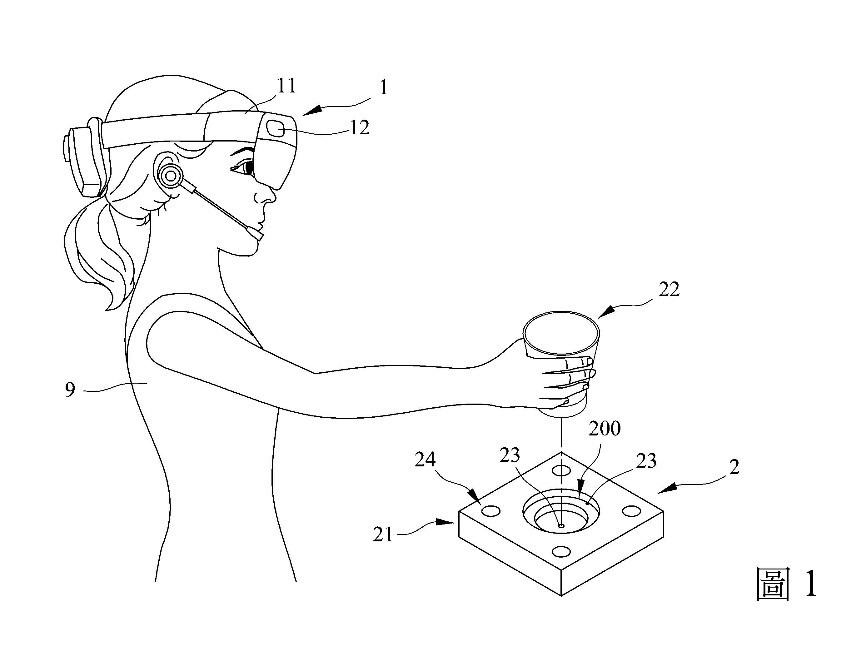
▲Caption: This figure illustrates the operational scenario of the interactive rehabilitation system of the present invention. The user wears an augmented reality device, which includes a display module and a sensing module for displaying virtual images and tracking user movements. The user holds the main body with both hands to perform rehabilitation training movements such as picking up and placing, aligning or placing it into the target position set on the base. The base has multiple sensing holes and positioning areas to detect movement accuracy and transmit it back to the system for analysis, achieving the effect of movement guidance and feedback training.
Application Examples
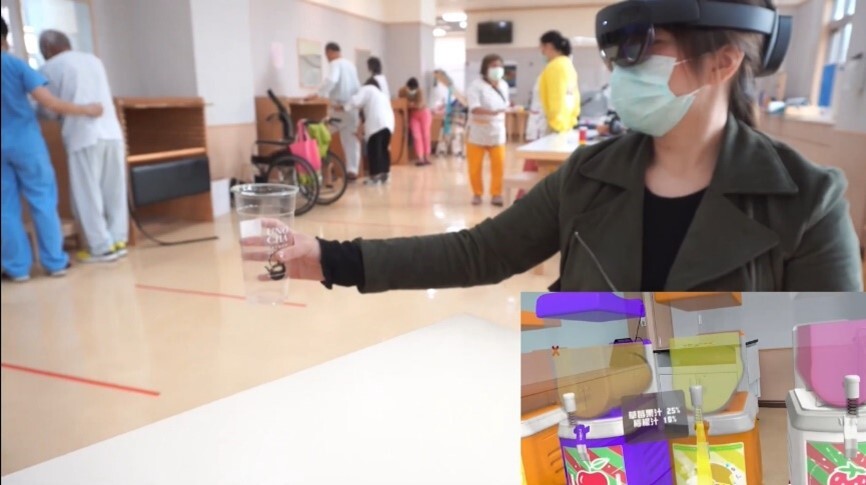
After wearing the MR headset, users can see virtual objects and task instructions on a real desktop and operate the interactive main body with both hands according to prompts to complete actions such as picking up and placing. The training goal is to strengthen upper limb motor control and improve hand-eye coordination and concentration. The system detects hand position and movement trajectory in real-time through base sensors, combined with visual and audio feedback, providing immediate assessment of movement accuracy and completion efficiency. This technology integrates physical operation and virtual interaction, making the rehabilitation process more immersive and challenging, effectively increasing user engagement and willingness to continue training, demonstrating the auxiliary value of MR technology in motor and cognitive rehabilitation.
Related Links
None
Patent Name and Number
None
Industry-Academia / Tech Transfer Partner
None
Honors and Awards
None
Technical Contact
Yu-Hui Huang, Manager
I-SHOU University
Tel: +886 7-6577711 ext. 2194
Email: yuhuihuang@isu.edu.tw