
﹤Biotech & Biomed Innovation﹥ADHD Auxiliary Diagnosis Examination Chair
I-SHOU University / Prof. Wu Jung-Ching
Pain Points Solved
1. Traditionally, the diagnosis of Attention Deficit Hyperactivity Disorder (ADHD) relies on the DSM-V, using subjective inquiries and scales from teachers, parents, and physicians. There is a lack of objective, scientific tools, leading to potential over-diagnosis or under-diagnosis.
2. Evaluation of treatment efficacy also relies on scales, which can be subjective based on the observer's preferences.
3. Different observers may have inconsistent evaluations of efficacy due to differing viewpoints.
4. This study utilizes an examination chair equipped with piezoelectric materials, gyroscopes, and accelerometers to objectively assess ADHD symptoms, achieving scientific diagnosis.
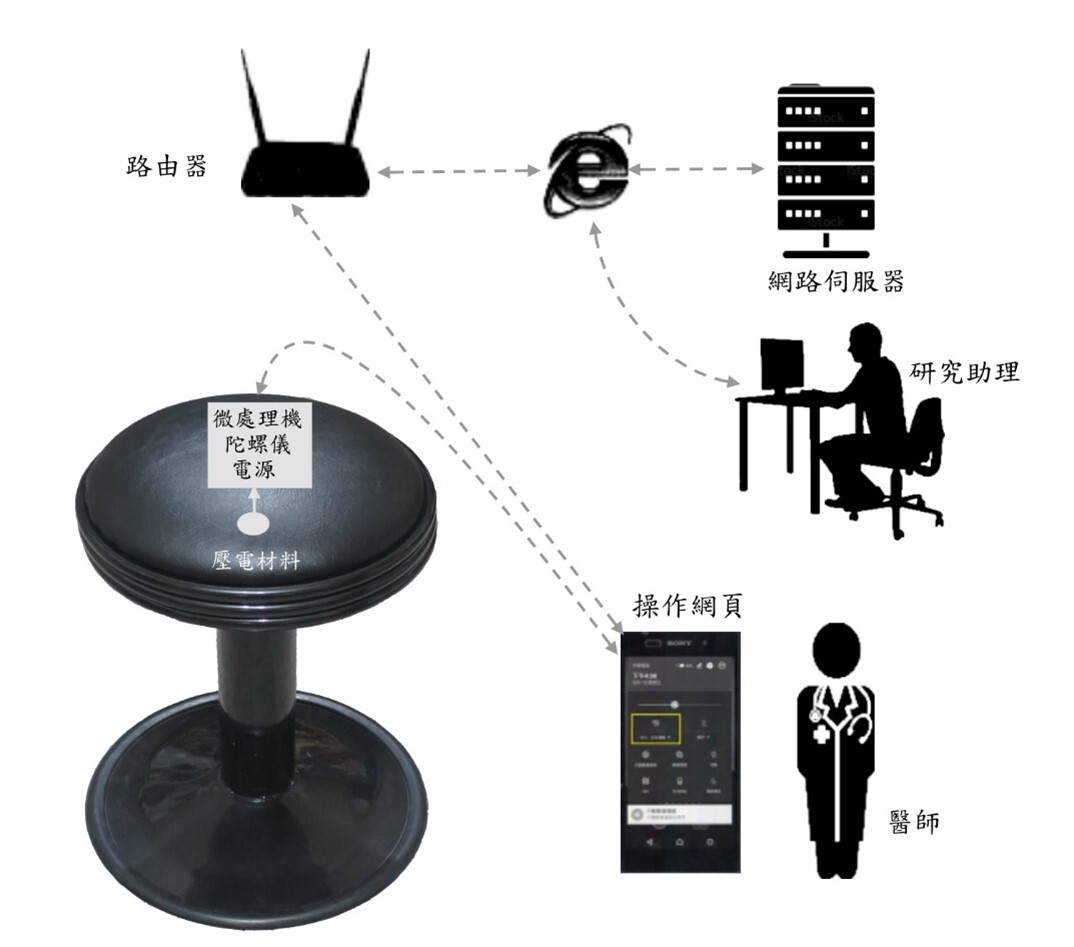
5. Patients inevitably sit on the examination chair when entering the clinic. Leveraging this, the chair is modified into a smart examination chair to collect data without interfering with children's normal activities.
6. Provides objective pre- and post-treatment tracking and comparison.
7. Advantages over traditional scales include objectivity, convenience for long-term recording, and capability for pre/post comparison.
Technology Introduction
This work develops a smart examination chair specifically to assist in ADHD assessment as an objective evaluation tool. It achieves two goals: real-time analysis and database establishment. The smart chair, consisting of sensors, a microprocessor, and a power converter, is placed in the clinic. Its sensors include piezoelectric materials (sensitive to vertical movement) and gyroscopes (sensitive to horizontal movement), which complement each other to sense and record activity details. When a subject sits down, recording begins; when they leave, the microprocessor calculates feature values (Variance (VAR), Zero-crossing rate (ZCR), High-energy rate (HER)) for immediate physician reference. An ESP32 microprocessor constructs an IoT system, acting as a web server for client monitoring via mobile phones. Data is uploaded to a database after the session for monitoring and analysis by authorized medical personnel, supporting future clinical research and system improvement.
Application Examples
To distinguish movement differences between ADHD patients and normal subjects, 62 children (31 with ADHD, 31 without) participated. All sat on the examination chair and were examined by a pediatric neurologist. We compared four classification performance metrics (sensitivity, specificity, AUC, accuracy) across seven feature sets and classifiers. The feature set containing VAR, ZCR, and HER performed best. Among all combinations, VAR and ZCR + XGBoost yielded the highest sensitivity (93%), All + KNN yielded the highest specificity (94.50%), VAR + SVM and All + KNN yielded the highest AUC (98%), and All + KNN yielded the highest accuracy (92.25%). Overall, feature sets containing VAR showed the best discrimination ability. ADHD patients had significantly higher VAR, ZCR, and HER than non-ADHD patients. The classification performance was excellent, with AUC reaching 98%, making this method a potentially useful and objective tool for ADHD diagnosis.
Related Links
https://www.youtube.com/watch?v=MAL4BLEREJo
Patent Name and Number
ROC Patent I805347
Industry-Academia / Tech Transfer Partner
None
Honors and Awards
2023 National College Intelligent Innovation and Cross-Domain Integration Creation Competition, Noteworthy Award
Technical Contact
Yu-Hui Huang, Manager
I-SHOU University
Tel: +886 7-6577711 ext. 2194
Email: yuhuihuang@isu.edu.tw