
﹤Biotech & Biomed Innovation﹥ADHD Auxiliary Diagnostic Thermal Imager
I-SHOU University / Prof. Wu Jung-Ching
Pain Points Solved
ADHD diagnosis mostly faces three major limitations:
1. Objectivity and Precision: Current diagnosis relies on SNAP questionnaires, Vanderbilt ADHD diagnostic rating scales, and visual analogue scales. However, parents' or teachers' understanding of symptom descriptions may differ. Some parents may exaggerate facts to obtain medical subsidies, while others may hide symptoms out of fear of their child being labeled. Furthermore, differences in the subject's environment (school vs. home) lead to different behaviors, affecting judgments by teachers and parents.
2. Practicality: EEG equipment is expensive and requires sufficient medical manpower and maintenance capabilities, making it difficult to popularize in general clinics and schools. Moreover, ADHD patients generally cannot undergo EEG measurements quietly; the accompanying various interference waves are difficult to process and affect EEG feature analysis.
This article presents an assessment tool for ADHD auxiliary diagnosis:
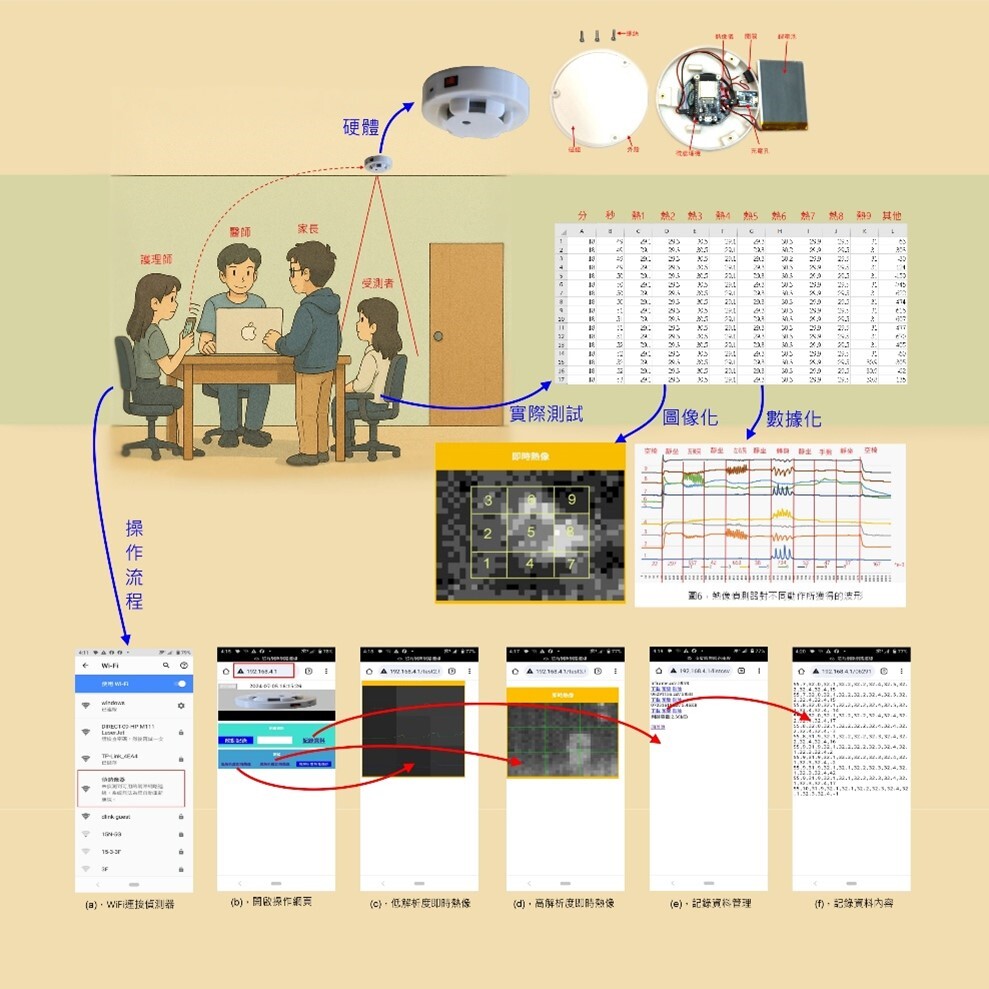
1. The detector is an infrared thermal imager combined with a single chip to detect and record the details of the subject's activities.
2. The smart remote detection system is placed on the consulting room ceiling. It looks exactly like a standard smoke detector, causing no sense of incongruity in any environment.
3. The ESP32 is designed as a web server, providing webpages to Web Clients for monitoring. Clients can set up and operate it directly via mobile phones; the operator only needs a mobile phone to easily turn on the smart remote detection system.
4. This device allows testing for several hours, providing ample testing time to minimize errors caused by intentional behavior.
5. The device is simple to install; even non-medical professionals can quickly install and detect after simple instruction.
Technology Introduction
This detector consists of a casing, infrared thermal imager, microprocessor, switch, charging/discharging module, battery, and smartphone. The infrared thermal imager features remote detection capabilities and, combined with a single chip, can detect and record details of the subject's activities. The device is turned on by the operator and installed on the ceiling. Signals from the infrared thermal imager module are sent to the microprocessor; calculation results are stored in the microprocessor and available for operator download. It features WiFi functionality to connect with a mobile phone. The smartphone acts as a slave (Web Client) device. The phone can connect to the host, using network transmission technology for settings and operations, and to enable the data recording function.
Application Examples
This work analyzes feature values based on different movements. It was found that this work can accurately display the magnitude of movements, which contributes to the future practical clinical application of this detector. This work uses a feature value of 15 as the critical threshold for movement/sitting still. When the feature value is greater than 15, it is judged as movement; when less than 15, it is judged as sitting quietly. The P-value for the actual/classified statistics of movement/sitting still is 0.009, with an accuracy of 0.9375 and precision of 1.0. This proves that the system has excellent detection and classification results for movement/sitting still.
Related Links
https://www.youtube.com/watch?v=zRmnhbBc7iY
Patent Name and Number
ROC Patent, Application No.: 114103353
Industry-Academia / Tech Transfer Partner
None
Honors and Awards
None
Technical Contact
Yu-Hui Huang, Manager
I-SHOU University
Tel: +886 7-6577711 ext. 2194
Email: yuhuihuang@isu.edu.tw