
﹤ESG and Circular Economy﹥Flame-retardant and solvent-resistant meltblown nonwoven technology
I-SHOU University / Prof. Yi-Cang Lai
Pain Points Solved
1.Overcoming the limited thermal and chemical resistance of conventional PP/PET meltblown materials
Conventional PP and PET meltblown nonwovens are prone to aging, degradation, or deformation under high-temperature, strong acid/alkali, or organic solvent environments. This technology uses PPS as the base material to enhance long-term reliability under harsh operating conditions.
2.Addressing unstable PPS meltblown processing and fiber formation difficulties
During PPS processing, the release of sulfur-containing volatiles can cause nozzle clogging, fiber breakage, and non-uniform web structures. Granulation pretreatment improves gas release and meltblown continuity, thereby enhancing process stability and mass-production feasibility.
3.Improving pore shrinkage and dimensional instability during high-temperature use
PPS meltblown fabrics may undergo pore shrinkage and embrittlement after prolonged thermal exposure. By incorporating a small amount of PEI, thermal shrinkage can be suppressed and the pore structure can be maintained, supporting applications in high-temperature filtration, protection, and thermal insulation.
Technology Introduction
This technology develops flame-retardant, heat-resistant, and solvent-resistant meltblown nonwoven fabrics using high-performance polyphenylene sulfide (PPS) as the base material. Granulation pretreatment is employed to improve gas release and fiber formation stability during PPS meltblown processing, while a small amount of PEI is incorporated to enhance dimensional stability and pore structure retention under high-temperature conditions. Compared with conventional PP or PET meltblown materials, this technology maintains excellent structural integrity in strong acid/alkali, organic solvent, and high-temperature environments, making it suitable for high-temperature gas filtration, protective materials, thermal insulation, and functional nonwovens for harsh environments.
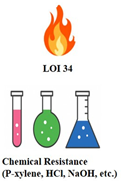
▲Caption: PPS meltblown nonwovens exhibit excellent flame retardancy and chemical resistance, with a limiting oxygen index (LOI) of 34, indicating good self-extinguishing and flame-resistant properties. The material also shows strong resistance to various chemical environments, including p-xylene, HCl, and NaOH, making it suitable for filtration and protective applications under high-temperature, corrosive, and harsh operating conditions.
Application Examples
This technology can be applied to high-temperature gas filtration materials, such as filters used in industrial exhaust systems, combustion equipment, dust collection systems, and high-temperature manufacturing processes. Compared with conventional PP or PET meltblown nonwovens, the developed PPS meltblown nonwoven exhibits superior heat resistance, flame retardancy, and resistance to acids, alkalis, and organic solvents. It can maintain fiber structure and pore stability under harsh operating conditions, reducing filter failure caused by thermal shrinkage, chemical corrosion, or combustion risks. In addition to high-temperature filtration, this technology can also be extended to protective clothing materials, thermal insulation materials, chemical-resistant filter media, and functional nonwovens for specialized industrial environments.
Related Links
None
Patent Name and Number
None
Industry-Academia / Tech Transfer Partner
None
Honors and Awards
None
Technical Contact
Prof. Yi-Cang Lai
I-SHOU University
Tel: +886 7-6577711
Email: yclai1212@isu.edu.tw