﹤ESG and Circular Economy、Green Energy, Power Saving﹥Interface Engineering and Data-Driven Optimization Technology Platform for Next-Generation Perovskite Solar Cells
National University of Kaohsiung / Prof. Jui-Yun Hsu
Pain Points Solved
Conventional perovskite solar cell development faces challenges such as interfacial defects, leakage current, and insufficient stability. In addition, the wide range of material compositions and processing parameters often requires extensive trial-and-error experiments for optimization, resulting in increased R&D time and costs.
This technology employs 4PABCz interfacial modification and APCl surface passivation to effectively reduce thin-film defects and charge-carrier losses, improving the power conversion efficiency (PCE) from approximately 16% to 22%. It further integrates SCAPS-1D simulations, XGBoost machine learning, and SHAP analysis to rapidly predict device performance and identify critical parameters affecting efficiency, achieving a PCE prediction accuracy of R² ≈ 0.99.
By integrating interface engineering with AI-driven data optimization, this dual-track technology reduces the cost of repetitive prototyping and material screening, shortens R&D cycles, and enhances device efficiency and stability, thereby accelerating the development and commercialization of high-efficiency, low-toxicity perovskite solar cells.
Technology Introduction
This technology provides comprehensive R&D capabilities for perovskite solar cells, covering material design, device fabrication, thin-film analysis, and AI-assisted optimization, and consists of two major platforms. The first is an inverted perovskite fabrication platform, which employs a 4PABCz self-assembled layer for interface modification and APCl surface passivation to reduce thin-film defects and leakage current, thereby improving device efficiency and stability. The second is a simulation and AI-assisted design platform, which uses SCAPS-1D to establish a lead-free dual-absorber device model and integrates XGBoost and SHAP analysis to predict device efficiency and identify key performance parameters, thereby shortening the time required for material screening and optimization.
By integrating experimental validation with data-driven design, this technology supports the development of high-efficiency, low-toxicity, and highly stable solar cells, with potential applications in green energy generation and net-zero sustainability.
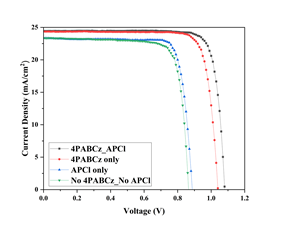
▲Figure 1. Comparison of the J–V characteristics of devices under different 4PABCz interface modification and APCl surface passivation conditions, demonstrating the synergistic enhancement achieved by dual modification.
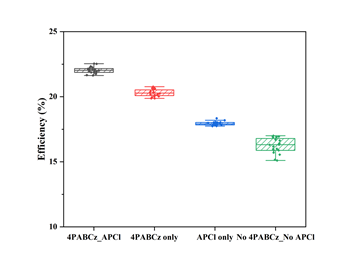
▲Figure 2. Comparison of power conversion efficiency (PCE) distributions under different interface modification/passivation conditions. The dual modification improves the PCE from approximately 16% to 22%.
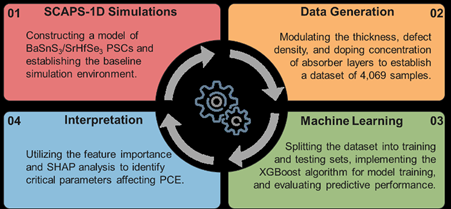
▲Figure 3. Schematic workflow of the data-driven optimization framework integrating SCAPS-1D simulation with machine learning (XGBoost/SHAP).
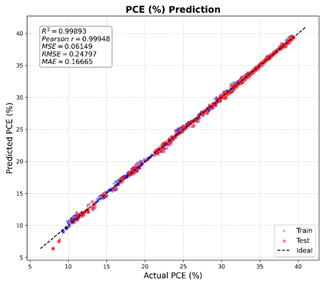
▲Figure 4. Prediction accuracy of the XGBoost model for power conversion efficiency (PCE), achieving R² ≈ 0.99.
Application Examples
This technology can be applied to perovskite solar cell material development, device fabrication optimization, and the development of novel optoelectronic materials. For example, solar cell R&D teams can employ 4PABCz interface modification and APCl surface passivation to reduce interfacial defects and improve charge-carrier transport, thereby enhancing the power conversion efficiency (PCE) and stability of the devices.
For the development of new materials or novel device structures, SCAPS-1D can be used to establish device models, while XGBoost and SHAP can analyze large sets of material and process parameters to predict power conversion efficiency and identify the key factors affecting device performance. This enables researchers to rapidly screen promising material combinations and optimize processing conditions.
In the future, this technology can be further applied to the solar cell manufacturing, optoelectronic materials, energy materials, and green energy technology industries. It can serve as a supporting tool for new material development, process parameter optimization, and R&D decision-making, accelerating the development of high-efficiency, low-toxicity, and highly stable solar cell technologies.
Related Links
None
Patent Name and Number
None
Industry-Academia / Tech Transfer Partner
None
Honors and Awards
None
Technical Contact
Vivian Lee, Administrative Assistant
National University of Kaohsiung
Tel: +886 7-5916639
Email: vivianlee@nuk.edu.tw