
﹤Biotech & Biomed Innovation﹥Composite and Use for Manufacturing Composition for Promoting Insulin Production Thereof
National University of Kaohsiung / Prof. LIN, HUNG YIN
Pain Points Solved
Background
-
Current Status of Diabetes
The global prevalence of diabetes continues to rise. Current treatment approaches—including dietary management, oral medications, and insulin injections—often suffer from poor patient adherence and can negatively impact quality of life. -
Emerging Trend in Gene Regulation
The CRISPR/Cas9 system has been widely adopted in gene therapy due to its high specificity and precise genome-editing capability. However, conventional transfection methods are often limited by high cytotoxicity and low delivery efficiency.
Technological Innovation
-
High Specificity and Safety: Regulates gene expression without inducing DNA double-strand breaks.
-
Low Cytotoxicity: Demonstrates lower cellular toxicity than conventional transfection systems.
-
Multifunctionality: Integrates gene regulation, drug delivery, and bioimaging capabilities into a single platform.
-
Multiplex Gene Regulation: Capable of carrying multiple guide RNAs (gRNAs) simultaneously, enabling the coordinated regulation of multiple target genes to enhance therapeutic efficacy.
Technology Introduction
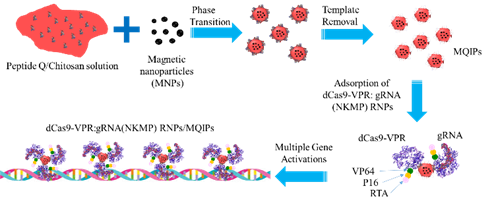
This technology utilizes Cas9 molecularly imprinted nanoparticles (MQIPs) in combination with Cas9 fusion proteins and guide RNAs (gRNAs) to form a functional delivery complex. The complex precisely regulates the expression of insulin production–related genes within target cells, thereby enhancing insulin secretion and offering a promising therapeutic strategy for diabetes treatment.
Application Examples
1. Diabetes Therapy
-
Serves as a gene therapy platform to enhance endogenous insulin secretion, reducing the dependence on exogenous insulin injections.
2. Cell Therapy and Regenerative Medicine
-
Can be applied to pancreatic β-cell functional restoration or stem cell differentiation, improving insulin-producing capacity.
3. Precision and Personalized Medicine
-
Enables the design of patient-specific guide RNAs (gRNAs) based on individual genetic profiles, facilitating precision medicine.
4. Image-Guided Therapy
-
The magnetic properties of MQIPs enable MRI-based tracking, allowing real-time monitoring of therapeutic delivery and treatment outcomes.
Related Links
Patent Name and Number
None
Industry-Academia / Tech Transfer Partner
None
Honors and Awards
None
Technical Contact
Vivian Lee, Administrative Assistant
National University of Kaohsiung
Tel: +886 7-5916639
Email: vivianlee@nuk.edu.tw