﹤Environmental Engineering﹥Photoelectrochemical Tri-Functional Integrated Platform Technology: High-Efficiency Water Pollution Treatment, Clean Energy Carrier Production, and CO2 Resource Utilization
National Sun Yat-sen University / Prof. Yen-Ping Peng
Pain Points Solved
With the rapid industrial development and extensive use of emerging chemicals, the types of contaminants in aquatic environments have become increasingly complex, causing conventional water treatment technologies to gradually encounter limitations. Meanwhile, the continuous promotion of global net-zero emission and low-carbon transition policies has driven environmental treatment technologies to not only enhance pollutant removal performance but also to simultaneously consider energy conversion and carbon resource utilization.
Based on these challenges, we develop an advanced integrated photoelectrochemical (PEC) redox system that enables high-efficiency removal of contaminants in water while further reducing the carbon dioxide generated from the mineralization of organic pollutants within the system to convert it into value-added products. In addition, clean energy carriers, such as hydrogen or ammonia, can be simultaneously produced via PEC system. Through this integrated design, the system achieves the synergistic integration of water pollution treatment, energy conversion, and carbon resource utilization.
Technology Introduction
This technology employs highly stable and recyclable titanate nanotube arrays (TNAs) as photoanodes in a photoelectrochemical system. The system consists of a three-electrode electrochemical workstation, a customized H-type reactor, and a light source, and integrates the synergistic effects of photocatalysis and electrocatalysis to achieve high-efficiency and reproducible photoelectrochemical operation.
Under illumination and applied bias, the photoanode promotes efficient separation and transport of photogenerated holes and electrons, enabling simultaneous oxidation and reduction reactions at the anode and cathode, respectively. The anode enables high-efficiency oxidative removal of contaminants in water, while the cathode facilitates the production of clean energy carriers and the reduction of carbon dioxide into value-added products.
Through this integrated tri-functional photoelectrochemical platform, the goals of water pollution remediation, energy carrier production, and carbon dioxide resource recovery can be achieved simultaneously.
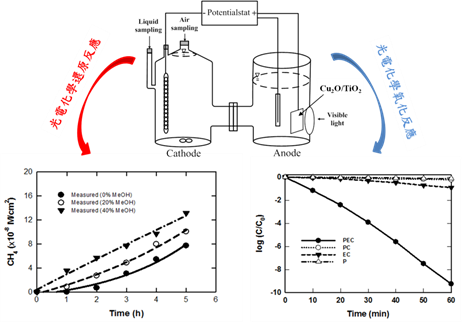
Figure. Photoelectrochemical system
Application Examples
-
High-efficiency removal of contaminants
This technology has been validated for water pollution treatment applications and demonstrates effective mineralization of a wide range of contaminants into carbon dioxide, including organic dyes (e.g., methyl orange), pharmaceuticals and personal care products (e.g., ibuprofen, diclofenac, and sulfamethoxazole), chlorinated organic compounds (e.g., trichloroethylene), and other highly persistent pollutants (e.g., tetramethylammonium hydroxide and perfluorooctanoic acid).
-
Simultaneous generation of energy and value-added products
While contaminants are mineralized into carbon dioxide, photogenerated electrons at the cathode are simultaneously verified to drive multiple reduction reactions, including water reduction for hydrogen production, nitrate reduction to ammonia, and carbon dioxide reduction to formate and methanol as value-added products.
Related Links
None
Patent Name and Number
None
Industry-Academia / Tech Transfer Partner
None
Honors and Awards
None
Technical Contact
Industrial Liaison Office
National Sun Yat-sen University
Tel: +886 7-5250165#2691
Email: gloria@mail.nsysu.edu.tw