﹤ESG and Circular Economy﹥Develop technologies for the recovery of high-value metals from waste batteries.
National Sun Yat-sen University / Professor Yuan-Chung Lin
Pain Points Solved
Biofuels can be regarded as one of the potential pathways to reduce dependence on fossil fuels and alleviate related unsustainable environmental issues. Specifically, they can address the following aspects:
Pyrometallurgy generates air pollution problems. Hydrometallurgy uses inorganic acids such as HCl, HNO₃, and H₂SO₄, which offer the advantages of low cost and high leaching efficiency but can cause severe secondary pollution. However, novel green solvents have been developed for metal extraction. Compared with traditional solvents, these new green solvents offer low cost, good thermal and chemical stability, easy biodegradability, and high solubility for metal oxides.
Technology Introduction
Waste lithium-ion battery cathode materials contain high-value metals such as cobalt (Co) and lithium (Li). Conventional hydrometallurgical processes typically use sulfuric acid, citric acid, or succinic acid for leaching, followed by extraction and stripping with phosphorus-based or amine-based agents. However, the high cost of extractants, generation of acidic waste, and the complexity of the extraction process significantly increase the recycling cost of spent batteries.
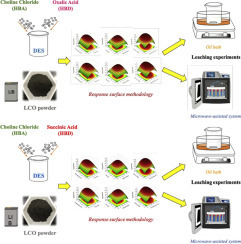
The research team employs a novel, environmentally friendly solvent in combination with microwave-assisted extraction to recover valuable metals, including cobalt (Co) and lithium (Li), from spent batteries. This approach offers several advantages, including low solvent costs, a simple operating procedure, high metal selectivity, and solvent reusability. Following electrochemical recovery, a cobalt recovery rate of up to 95.7% and a purity of 97.8% were achieved. Another metal recovery result demonstrated a recovery rate of 98.9% and a purity of 97.7%.According to spot market closing prices reported by the Shanghai Business Society as of October 21, 2026, cobalt with a purity of >99.8% was priced at RMB 235,000 per metric ton, while nickel with a purity of >99.9% was priced at RMB 119,510 per metric ton. These market prices highlight the potential economic value of recovering valuable metals from spent batteries. Overall, this approach offers a promising strategy for promoting resource circularity and environmental sustainability while enhancing the economic feasibility of spent battery recycling.
Application Examples
None
Related Links
None
Patent Name and Number
None
Industry-Academia / Tech Transfer Partner
None
Honors and Awards
None
Technical Contact
Industrial Liaison Office
National Sun Yat-sen University
Tel: +886 7-5250165
Email: gloria@mail.nsysu.edu.tw