﹤ESG and Circular Economy、Green Energy, Power Saving﹥Net-zero emission hydrogen production technology from biomass
National Sun Yat-sen University / Professor Yuan-Chung Lin
Pain Points Solved
Converting biofuels into green hydrogen can be regarded as one of the key environmental mitigation technologies in line with the national net-zero carbon reduction policy, effectively addressing the following issues:
- Rice straw is abundant globally, particularly in Asia, helping to reduce agricultural waste while promoting the utilization of renewable energy.
- Rice straw is a type of lignocellulosic biomass, and its rich cellulose content serves as a source for catalytic conversion into green hydrogen.
- In the Alkaline Thermal Treatment (ATT) method for hydrogen production, the conventional operating temperature is approximately 600°C. However, by using a self-developed high-efficiency catalyst, the reaction temperature can be lowered to 180–300°C, significantly reducing energy input and consumption, thereby aligning with the goals of the national net-zero carbon reduction policy.
Technology Introduction
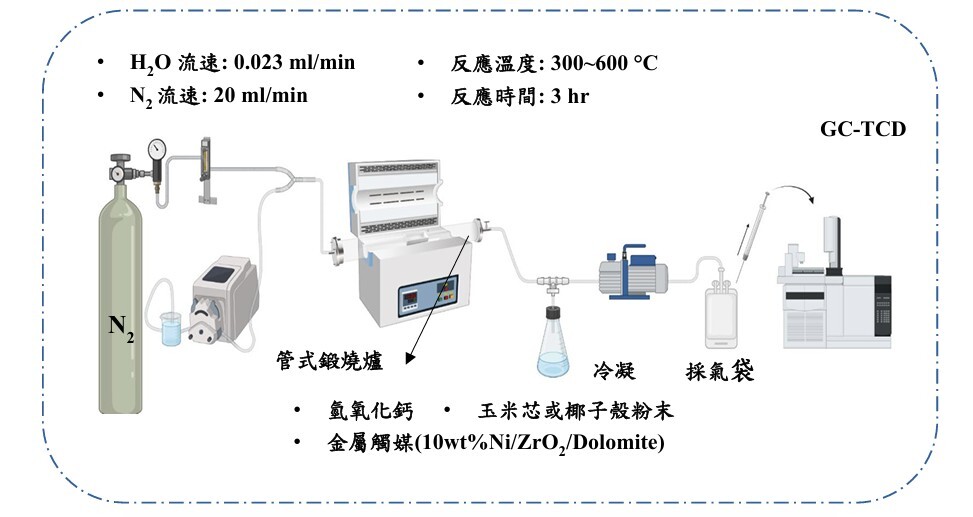
Biomass absorbs carbon from the atmosphere during its growth, thereby enabling a higher negative carbon emission potential. This study employs the Alkaline Thermal Treatment (ATT) method to convert the carbon captured during biomass reaction into high-purity H₂. By utilizing an efficient self-developed catalyst, the reaction temperature is reduced from a high of 600°C to a range of 180°C–300°C. In addition to reducing energy consumption, the added chemical agents transfer the chemical energy from the neutralization of biomass and alkali into high-purity H₂, while also capturing other acidic gases generated during the biomass conversion process, such as HCl and H₂S.
Our research team achieved a hydrogen production yield of approximately 58–69% using the ATT method. In summary, the carbon from the biomass is fixed in solid inorganic carbonates,resulting in the decarbonization of the produced fuel and achieving net-zero negative carbon emissions from biomass conversion.
Application Examples
None
Related Links
None
Patent Name and Number
None
Industry-Academia / Tech Transfer Partner
None
Honors and Awards
None
Technical Contact
Industrial Liaison Office
National Sun Yat-sen University
Tel: +886 7-5250165
Email: gloria@mail.nsysu.edu.tw