﹤ESG and Circular Economy、Green Energy, Power Saving﹥Production of Biodiesel Using High-Efficiency Catalysts Prepared from Waste Materials
National Sun Yat-sen University / Professor Yuan-Chung Lin
Pain Points Solved
Biofuels can be regarded as one of the potential pathways to reduce dependence on fossil fuels and alleviate related unsustainable environmental issues. Specifically, they can address the following aspects:
- Among non-edible oil sources, Jatropha curcas oil (JCO) is considered a highly promising feedstock for biodiesel production.
- Recycling waste into high-value-added, environmentally friendly catalysts and applying them to the biodiesel production process not only enhances the value of resource circular utilization but also achieves both economic benefits and environmental sustainability.
Technology Introduction
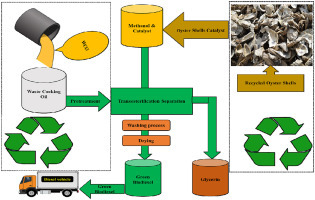
In this study, waste materials were crushed into fine powdered form and calcined to synthesize high-efficiency catalysts for biodiesel production. Using waste cooking oil and jatropha oil as feedstocks under operating conditions with only 5 wt% catalyst addition, biodiesel yields of 87.8% and 91.7% were obtained, respectively. In addition to achieving a yield from waste cooking oil comparable to that from feedstock oil, this study addresses the issue of waste landfill disposal while also reducing dependence on fossil fuels.
Application Examples
None
Related Links
None
Patent Name and Number
None
Industry-Academia / Tech Transfer Partner
None
Honors and Awards
None
Technical Contact
Industrial Liaison Office
National Sun Yat-sen University
Tel: +886 7-5250165
Email: gloria@mail.nsysu.edu.tw