﹤Biotech & Biomed Innovation﹥A Novel Rehabilitation System Integrating Brain-Computer Interface (BCI)
Kaohsiung Medical University / Prof. Chia-Hsin Chen
Pain Points Solved
- Traditional treadmill-based or fixed rehabilitation devices often fail to replicate real-world walking conditions, resulting in unnatural gait patterns. The ground-based mobility design provides a more realistic walking experience, enhancing gait recovery and rehabilitation outcomes.
-
Conventional rehabilitation lacks real-time monitoring of neural and physiological conditions, making it difficult to optimize training intensity. By combining AI-based brainwave recognition and physiological monitoring, the system delivers personalized rehabilitation strategies, reduces risks, and promotes neuroplasticity.
Technology Introduction
The Novel Rehabilitation System Integrating Brain-Computer Interface (BCI) breaks the limitations of traditional gait rehabilitation technologies, offering a more flexible and natural gait training experience. Designed with ground-based mobility, the system accurately simulates real-world walking environments and features a modular, multifunctional training mode to accommodate different rehabilitation stages.
An asymmetric dynamic weight support mechanism effectively enhances hip swing angles, optimizing gait recovery. By integrating AI-powered brainwave recognition and real-time physiological monitoring, the system not only improves rehabilitation safety but also provides personalized data analysis. It can monitor cortical activity post-stroke in real time, reduce cardiovascular disease risks, and promote neuroplasticity, significantly enhancing rehabilitation outcomes and helping patients regain mobility.
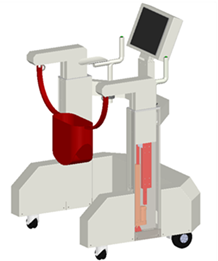
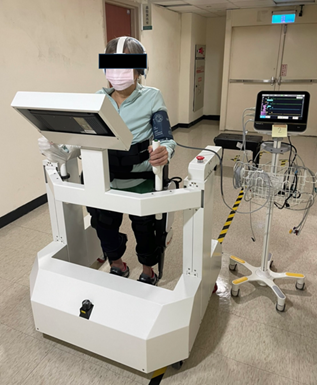
Figure. A Novel Rehabilitation System Integrating Brain-Computer Interface (BCI)
Application Examples
- For patients with post-stroke lower-limb impairments, the system monitors cortical activity in real time while providing dynamic weight-supported gait training to improve coordination, balance, and independent mobility.
-
The system is suitable for individuals with spinal cord injuries, traumatic brain injuries, or age-related mobility decline. Its modular training modes and personalized data analytics allow tailored rehabilitation programs for different recovery stages, improving rehabilitation efficiency and long-term care outcomes.
Related Links
None
Patent Name and Number
TW I758993、TW I554263、TW I661820、TW I836688、TW I784789
US 17/536,460、US 17/832,996
Industry-Academia / Tech Transfer Partner
None
Honors and Awards
The 16th National Innovation Award – Clinical Innovation Award
Technical Contact
Prof.Chia-Hsin Chen
Tel: +886 7-3121101 ext. 5712
Email: chchen@kmu.edu.tw