
﹤Biotech & Biomed Innovation、Artificial Intelligence﹥Infrared temperature sensing system
I-SHOU University / Prof. Rong-Ching Wu
Pain Points Solved
Conventional infrared thermal imaging devices can be costly and may suffer from limited temperature accuracy and sensing distance. According to the technical description, temperature deviations in some commercial systems may reach ±5°C, while attenuation of received thermal radiation can further restrict screening range. Integrating face detection and mask recognition may also increase processing demands. This technology addresses these challenges through a low-cost embedded platform, temperature calibration, distance compensation, and integrated image recognition. Its goal is to support more accurate, portable, and practical temperature screening without substantially compromising system performance.
Technology Introduction
The system combines a Raspberry Pi 4 embedded platform with a FLIR Lepton 3.5 thermal imaging camera to provide a compact and cost-conscious infrared temperature sensing solution. Two temperature sensing units establish reference and ambient temperatures. An infrared sensor then measures these references and the target, while a processing module applies interpolation to estimate the corrected target temperature. The platform also integrates high-temperature masking, automatic calibration, distance compensation, face detection, and mask recognition. The reported results indicate temperature accuracy within ±0.3°C after calibration and an effective screening distance exceeding five meters.
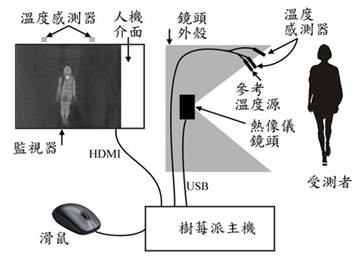
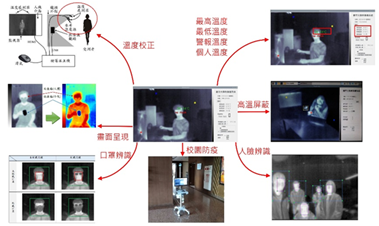
▲Caption: System architecture and functional illustration showing the thermal camera, reference temperature sensors, subject, embedded processing platform, and the workflows for thermal imaging, temperature calibration, face detection, and mask recognition.
Application Examples
The system can be deployed for contactless temperature screening at entrances and in shared spaces. Its thermal imaging camera captures temperature information, while automatic calibration and distance compensation improve measurement reliability. The reported research results indicate screening accuracy within ±0.5°C after compensation and an effective range of more than five meters. Face detection and mask recognition can operate concurrently to support screening workflows. With its compact embedded hardware and relatively low-cost design, the technology may be suitable for deployment in schools, institutions, and access-control areas where portable temperature screening is needed.
Related Links
None
Patent Name and Number
中華民國發明專利證號:I880790。
Industry-Academia / Tech Transfer Partner
None
Honors and Awards
None
Technical Contact
Prof. Rong-Ching Wu
I-SHOU University
Tel: +886 7-6577711 ext. 6636
Email: rcwu@isu.edu.tw