
﹤Biotech & Biomed Innovation、Mechanical and Electronic Engineering﹥Design and Manufacturing Method of Artificial Joints
National Pingtung University of Science and Technology / Prof. Lee Wen-Tsung
Pain Points Solved
Traditional artificial knee joints (exoskeletons) only allow single-plane movement and cannot reproduce the complex multi-axis activity of the human knee, leading to unnatural gait and increased burden on muscles and ligaments. This technology uses a multi-degree-of-freedom joint design to mimic physiological movement trajectories, improving gait naturalness, reducing joint wear, enhancing comfort and implant lifespan, and improving the patient's quality of life.
Technology Introduction
This study utilizes spatial mechanisms to simulate human walking posture, synthesizing a spatial mechanism capable of mimicking natural human steps. Since the design of spatial mechanisms is difficult to implement in a practical manner for artificial knee joints, the RRSS spatial mechanism was designed into a corresponding axode gear mechanism set using the linkage's fixed axode and moving axode. This makes it more suitable for the installation and manufacturing of artificial knee joints (exoskeletons).
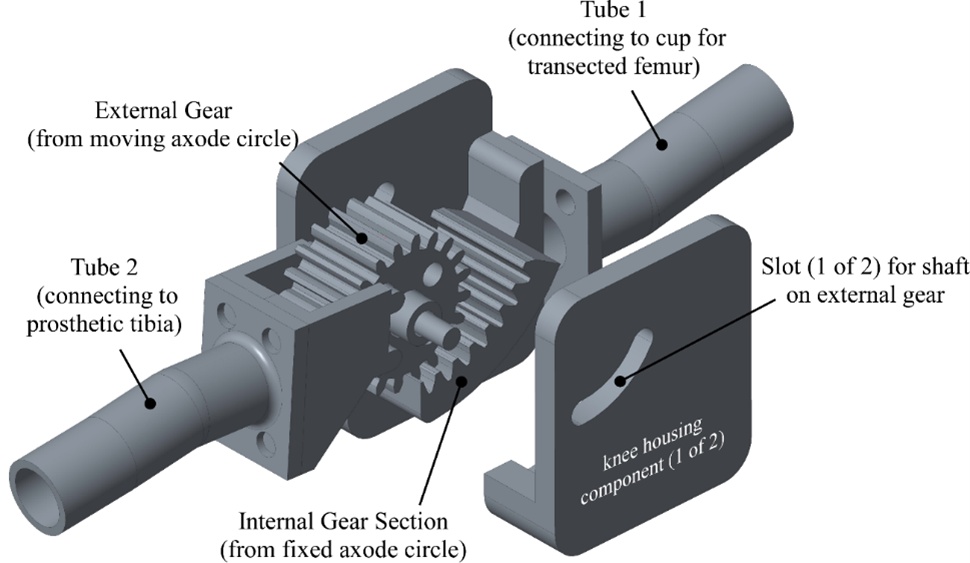
Figure 1. CAD Design Model
Application Examples
Traditional artificial knee joints (exoskeletons) only allow single-plane movement and cannot reproduce the complex multi-axis activity of the human knee, leading to unnatural gait and increased burden on muscles and ligaments. This technology uses a multi-degree-of-freedom joint design to mimic physiological movement trajectories, improving gait naturalness, and enhancing comfort.
Related Links
None
Patent Name and Number
I642419
Industry-Academia / Tech Transfer Partner
None
Honors and Awards
None
Technical Contact
Joan Li, Project Manager
National Pingtung University of Science and Technology
Tel: +886 8-7703202 ext. 6571
Email: joanli@mail.npust.edu.tw