﹤ESG and Circular Economy﹥Development and Application of Photosynthetic Bacteria for Enhancing Carbon Sink Benefits
National Pingtung University of Science and Technology / Prof. Yu-Ting Wu
Pain Points Solved
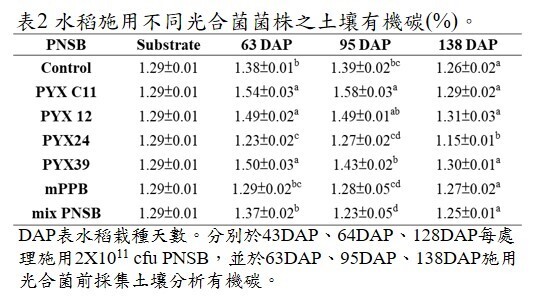
In order to mitigate climate change, Taiwan formulated the "Greenhouse Gas Reduction and Management Act" in 2015, setting a long-term goal that "greenhouse gas emissions in 2050 should be reduced to less than 50% of 2005 emissions." Energy saving and carbon reduction have become urgent priorities, reducing carbon emissions through energy transition goals and pathways. This study isolated and purified 4 strains of purple non-sulfur bacteria (PNSB) from lake and mangrove environmental samples, specifically PYX 12, PYX C11, PYX 39, and PYX 24, and established two methods to evaluate their carbon sequestration benefits. Method 1 cultured the photosynthetic bacteria in a carbon-free medium with 6% CO2 added and measured bacterial counts under fixed lighting. Method 2 measured the amount of electrons excited after light exposure (Junior PAM, Walz). The results showed that isolate PYX 12 had the best efficiency in utilizing CO2. Calculated based on Ritchie (2013), 2×10⁹ cfu of the PYX 12 strain can generate nearly μmol (e-) mg BCl ɑ-1 h-1, which is equivalent to capturing 2197 μg of CO2. Furthermore, the 4 strains of photosynthetic bacteria were mass-cultured individually and applied to rice for pot experiments to verify carbon sink benefits. The experiment found that the rice in the experimental groups with added photosynthetic bacteria grew better than the control group without addition, and the plant biomass (g, dw) ranked from high to low was: isolate PYX 12 > PYX C11 > PYX 24 > PYX 39. Regarding soil carbon sequestration, PYX 12 also currently shows the most potential.
Technology Introduction
The greatest feature of this study is the development of a carbon sink benefit assessment method to screen for photosynthetic bacterial strains with high carbon capture efficiency in the environment and the establishment of a mass production system. Two methods were established to evaluate the carbon fixation benefits of photosynthetic bacterial strains: Method 1 cultures the photosynthetic bacteria in a carbon-free medium with 6% CO2 added and measures bacterial counts under fixed lighting; subsequently, Method 2 measures the amount of electrons excited after light exposure (Junior PAM, Walz). This method can rapidly assess the carbon fixation activity of strains to screen for photosynthetic bacterial strains with high carbon fixation benefits for use in crop cultivation. Simultaneously, it can be paired with negative-carbon crops to achieve maximum carbon sink benefits, promoting the industrial application of photosynthetic bacteria and providing technological competitiveness.
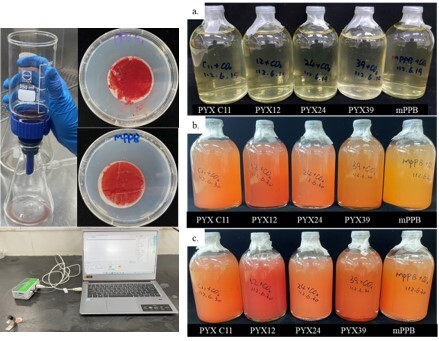
Figure 1. Assessment of carbon fixation efficiency of purple non-sulfur bacteria strains. Left image shows the measurement of electron amount excited after light exposure (Junior PAM, Walz); Right image shows photosynthetic bacteria cultured in carbon-free medium with 6% CO2 added and bacterial counts measured under fixed lighting. (a) Day of inoculation; (b) Day 3 of photosynthetic bacteria inoculation; (c) Day 5 of photosynthetic bacteria inoculation. Table 1 Data: Shows rETR, ETR, and Captureable CO2 for different PNSB strains (PYX C11, PYX 12, PYX 24, PYX 39, mPPB).
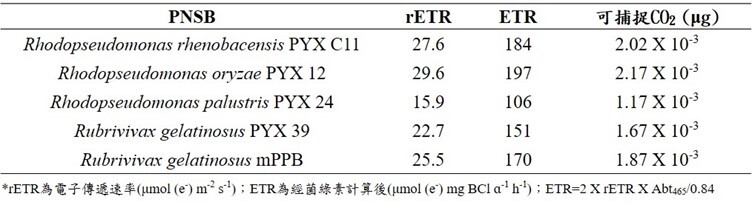
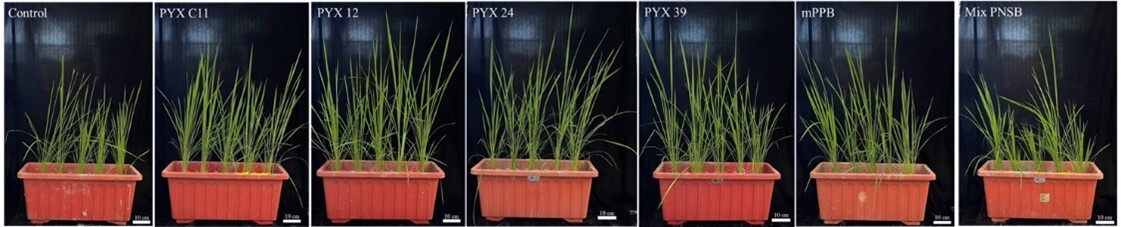
Figure 2. Rice Pot Experiment - 64 DAP. Table 2 Data: Soil organic carbon (%) of rice with application of different photosynthetic bacterial strains at various DAPs (Days After Planting). Note: 2X10^11 cfu PNSB applied at 43, 64, and 128 DAP; soil sampled for organic carbon analysis at 63, 95, and 138 DAP.
Application Examples
Photosynthetic bacteria are used in agriculture to promote crop growth, improve soil pH, and strengthen crop root systems. The photosynthetic bacterial strains isolated in this product have high carbon capture efficiency. When applied to the soil in combination with crops, they can simultaneously enhance crop yield and soil carbon sink benefits, achieving environmental sustainability.
Related Links
None
Patent Name and Number
None
Industry-Academia / Tech Transfer Partner
None
Honors and Awards
None
Technical Contact
Joan Li, Project Manager
National Pingtung University of Science and Technology
Tel: +886 8-7703202 ext. 6571
Email: joanli@mail.npust.edu.tw