
﹤Biotech & Biomed Innovation﹥Real-time Multitasking Video-Assisted Intubation System
Kaohsiung Medical University / Prof. Kuang-I Cheng
Pain Points Solved
- Inexperienced or junior physicians may mistakenly insert the laryngoscope into the esophagus during oral intubation, which can lead to hypoxia or even death of the patient.
- Traditional intubation relies heavily on manual judgment and lacks real-time positioning and navigation assistance, resulting in higher medical risks and an increased likelihood of medical disputes.
- In emergency and surgical environments, physicians face a steep learning curve, making it difficult to balance operational efficiency and patient safety.
Technology Introduction
In modern clinical medicine, inexperienced doctors may mistakenly insert a laryngoscope into a patient's esophagus during intubation, which can lead to choking and irreversible consequences. This can also result in medical disputes. The methods used in this paper include object detection, edge detection, symmetry detection, and visual odometry. A laryngoscope positioning and navigation system is required to reduce the risk of incorrect insertion by doctors during intubation. We propose the use of LARP object detection technology in the laryngoscope positioning and navigation system. The system aims to provide doctors with guidance on the correct direction and location for laryngoscope insertion in real time, ensuring the safety and efficiency of the intubation process.
Positioning Guide
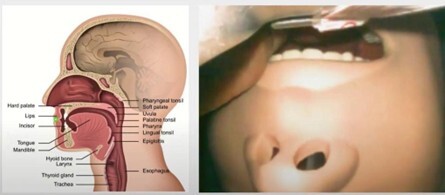
Figure1. Oral Insertion
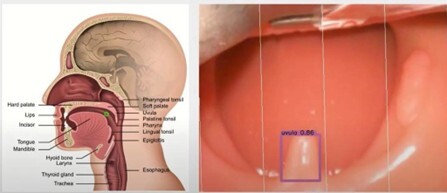
Figure2. Uvula Positioning Guide
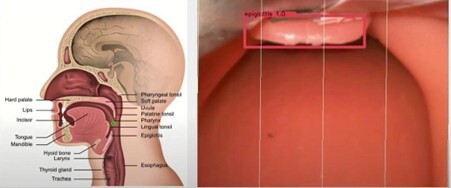
Figure3. Epiglottis Positioning Guide
Application Examples
- The system integrates object detection, edge detection, symmetry analysis, and visual odometry to provide real-time positioning and navigation of the laryngoscope.
- By utilizing LARP object detection technology, the system assists physicians in real time to identify the correct direction and location of the trachea, preventing accidental insertion into the esophagus.
- This technology is applicable to emergency intubation, anesthetic intubation, and clinical training scenarios, effectively improving intubation success rates and enhancing patient safety.
Related Links
None
Patent Name and Number
US 18/407,636
TW I790176
Industry-Academia / Tech Transfer Partner
None
Honors and Awards
None
Technical Contact
Mr. Hung, Assistant Manager
Kaohsiung Medical University
Tel: +886 7-3121101 ext. 2360
Email: R121084@kmu.edu.tw