
﹤Semiconductor Technologies﹥The algorithm of single-term trace function
I-SHOU University / Prof. Yaotsu Chang
Pain Points Solved
If x is an element in a finite field GF( , then the trace function Tr(x) of x is defined as follows:

Our patent uses the simplest method to obtain the trace function value: for example, for an 8-bit element (n=8) in a finite field GF( :
:

To find the trace function value Tr(x), here is a comparison between the current method and our method:
|
|
|
|


The more complex the formula, the more components are needed for hardware implementation, which in turn consumes more energy and takes more time.
Technology Introduction
All text, images, photos and videos seen, and all sounds and music heard on mobile phones (or on televisions and computer screens) are processed through digital technology (or simply, they are all related to a string of 0s and 1s). Finite field theory is an important mathematical theory used to deal with 0s and 1s, playing a crucial role in encoding, cryptography, and communication applications. It can also be used in quantum technology applications.
Among the applications of finite fields, the trace function is an important function, used in encoding, cryptography, and communication.
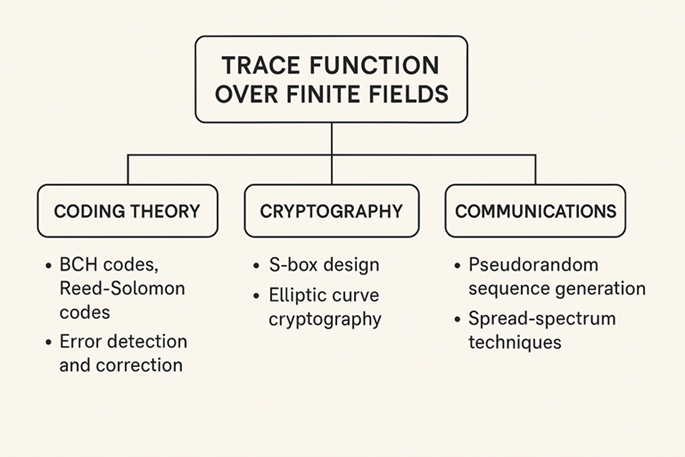
Application Examples
1. Practical Applications in Coding Theory
- Example: In the construction of BCH codes, Reed-Solomon codes, Goppa codes, etc., trace functions are often used to define check equations.
- Industrial Applications:
- The underlying error correction codes (ECC) used in storage devices (such as CD/DVD, Blu-ray, SSD) may utilize trace functions to construct linear equations over finite fields.
- In error correction code standards for satellite and deep space communication (NASA, ESA), trace mapping is directly used in some construction formulas.
2. Practical Applications in Cryptography
- Example: In the S-box design of some stream ciphers and block ciphers, trace functions are used to:
- Map elements of the extension field GF(
 ) to the base field GF(2)
 - Construct Boolean functions with good nonlinear properties.
- Industrial Applications:
- While AES's S-box is primarily based on inverses and affine transformations, some featherweight encryption algorithms (such as certain IoT encryption protocols) directly construct mappings using trace functions within the S-box or hybrid layers.
- In elliptic curve cryptography (ECC), trace functions are used in fast dot product algorithms for certain families of curves (especially Koblitz curves) to determine certain element properties (e.g., Frobenius endomorphism acceleration).
3. Applications in Communication Systems
- Examples: In spread spectrum communication, M-sequence, and Gold sequence construction, trace functions are used to generate pseudo-random sequences (PN sequences).
- Industrial Applications:
- Some pseudo-random codes used in GPS satellite navigation systems incorporate trace functions in their construction formulas.
- Some sequence generation algorithms in the 5G NR standard (such as parameter generation for Zadoff-Chu sequences) involve finite field operations based on trace mappings.
Summary:
Trace functions are behind-the-scenes mathematical tools in these industrial applications. They don't appear directly in the standard names seen by users, but rather in the underlying formulas of protocols, chip designs, or coding structures. Its practicality has been proven, and it continues to be used in industrial systems such as error correction codes, cryptographic algorithms, and pseudo-random code generation.
Related Links
None
Patent Name and Number
I742371
Industry-Academia / Tech Transfer Partner
None
Honors and Awards
None
Technical Contact
Yu-Hui Huang, Manager
I-SHOU University
Tel: +886 7-6577711 ext. 2194
Email: yuhuihuang@isu.edu.tw